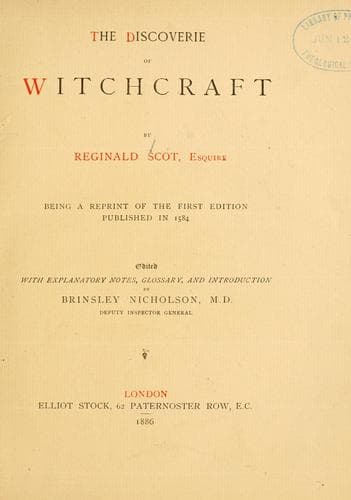
Demonology -- Early works to 1800; Magic -- Early works to 1800; Witchcraft -- Early works to 1800
ABSTRACT OF INQUIS. P.M., 45 ELIZ., PARS. 1, No. 71.
_Inquisition taken at Maidstone, 2 Dec. [1602], after the death of
Reginald Scot, generosus._
He was seised of a tenement and 20 acres of land called
Graynecourtte, held of Th. Scott, Esq., as of his manor of
Brabourne, a tenement called Essex, and 20 acres of land in two
parcels in Allington [Aldington], held of Edw. Hall, as of his
manor of Pawlson. One parcel of land called Haythorne field,
containing 20 acres in Bonington, held of the Queen in capite, and
a tenement and one parcel of land lying in Barefield, containing
two acres in Brabourne, tenure unknown, and one acre in Brabourne
and 5 acres in Brabourne, and two parcels in Smeeth, and 30 acres
of marsh called Gatesleaf, in Newchurch, held of Martin Barneham,
Esq., as of his manor of Bylsyngton.
He died 9 Oct., 41 Eliz. [1599], at Smeeth.
Elizabeth, wife of Sackville Turner, gent., is his daughter and
next heir, and was 28 years of age and more at his death.
Alice, his widow, has received the rents since his death.
[Elizabeth was the next heir to his own property, but that which
was his own through his wife Alice, he specially devised “to her
and to _her_ heirs”.]
————————————
_The Cause and History of the Work._—That is, what induced Scot to
write it, and why did he set it forth as he did? inquiries which
involve, among other matters, a short notice of the position then and
previously held by witchcraft in England. His _Hoppe-garden_ shows him
to us as a man of intelligence, foresighted and reflective of thought,
and desirous of improving the state of his country and countrymen. It
shows him also as one who could not only seize a thought and commend
it to others, but as one who had perseveringly put his idea into
practice, found it feasible, and then so learnt the processes necessary
for growing the plant, and preparing its catkins and storing them for
use, that a priori one would suppose that he had done what he did not,
namely, visited Holland and learnt the processes on the spot. The same
qualities are seen in his _Witchcraft_, as is also his independence of
thought. No sooner had his suspicions been aroused than he proceeded,
as shown by the work and its references, to investigate the matter
thoroughly and perseveringly. To this also he was encouraged, or rather
led, by yet other two qualities, his straightforwardness or honesty of
purpose, and his compassion, for these taught him that he was engaged
in a righteous work, that of rescuing feeble and ignorant, though it
may be too pretentious and shrewish, old women from false charges and a
violent death, and in a noble work in endeavouring to stem the torrent
of superstition and cruelty which was then beginning to overflow the
land.
Public-domain text, read in full here on John Shaqi.
Reviews
Reviews
No reviews yet
Be the first to share your thoughts on this work.
Join the Discussion
Join the discussion
Sign in to leave a comment or review.
Sign InorCreate an account