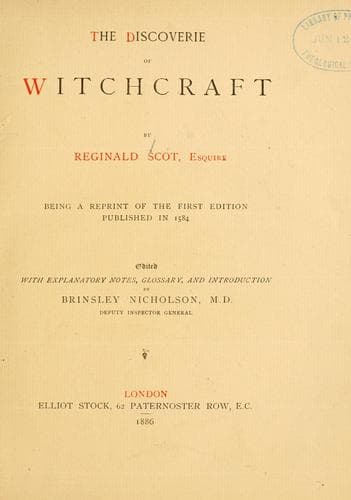
Demonology -- Early works to 1800; Magic -- Early works to 1800; Witchcraft -- Early works to 1800
_The division of augurie, persons admittable into the colleges
of augurie, of their superstition._
The latter divinors in these mysteries, have divided their soothsaiengs
into twelve superstitions: as _Augustinus Niphus_ termeth them. The
first is prosperitie; the second, ill lucke, as when one goeth out
of his house, and seeth an unluckie beast lieng on the right side of
his waie; the third is destinie; the fourth is fortune; the fift is
ill hap, as when an infortunate beast feedeth on the right side of
your waie; the sixt is utilitie; the seventh is hurt; the eight is
called a cautell, as when a beast followeth one, and staieth at any
side, not passing beyond him, which is a signe of good lucke; the
ninth is infelicitie, and that is contrarie to the eight, as when the
beast passeth before one; the tenth is perfection; the eleventh is
imperfection; the twelfe is conclusiin.[*] Thus farre he.
♦_Aug. Niphus de auguriis, lib. 1._♦
♦[*] [_read_, —sion]♦
Among the _Romans_ none could be received into the college of augurors
that had a bile, or had beene bitten with a dog, &c: and at the
times of their exercise, even at noone daies, they lighted candels.
From whence the papists conveie unto their church, those points
of infidelitie. Finallie, their observations were so infinite and
ridiculous, that there flew not a sparkle out of the fier, but it
betokened somewhat.
♦Who were not admittable into the college of augurors among the Romans.♦
The xv. Chapter.
_Of the common peoples fond and superstitious collections and
observations._
Public-domain text, read in full here on John Shaqi.
Reviews
Reviews
No reviews yet
Be the first to share your thoughts on this work.
Elsewhere in the archive
Join the Discussion
Join the discussion
Sign in to leave a comment or review.
Sign InorCreate an account