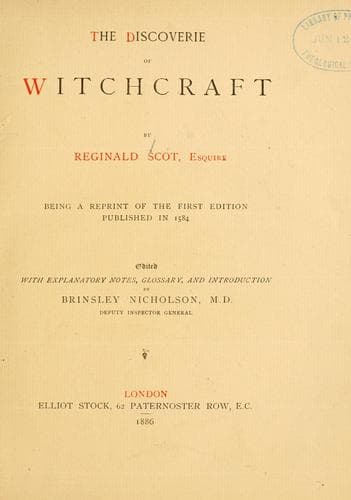
Demonology -- Early works to 1800; Magic -- Early works to 1800; Witchcraft -- Early works to 1800
Turning back to this burning, I would say also that I have not come
across any English contemporary, or even early statement as to it, much
less as to its date. Perhaps, however, without much fear of error, we
may suppose it to have been done immediately after the Act against
witches, passed in the first year of James’s reign. By it the Act 5
Eliz. was repealed, and any conjuration, etc., of an evil spirit was
made a crime punishable by death as a felon, the culprit losing all
benefit of clergy and sanctuary. The finding of treasure by magical
means, provoking to unlawful love, or destroying of cattle, was for
the first offence to bring with it imprisonment for one year, standing
in the pillory once a quarter for six hours, and confessing his crime,
as in the Act repealed; and for the second offence death as a felon,
though the dowry and the heirship were not attainted. This Act itself
shows how strong were James’s convictions in the matter, as does the
publication in London of his _Dæmonologie_ in the same year, it being
entered on the Stationers’ Registers on the 3rd April 1603. Scot’s book
was therefore against James’s belief, and the esteem in which it was
held against his own powers as a reasoner and author. While, however,
so far as I can find, we owe the knowledge of this burning to a German
source, its extreme likelihood is corroborated by what I have said,
that James’s belief in witchcraft was with him an undoubted Article of
Faith, and by the fact that various books, known and unknown, were at
different times publicly burnt during his reign, though no official
records of these burnings have been preserved.
Cole, as quoted in Bliss’s edition of the _Athen. Oxon._, gives the
account as made by Thomasius de crimine magiæ, a book which I believe
does not exist. There is a Thesis inaugaralis de crimine magiæ
submitted in 1701 by Johan Reiche to the Regia Academia Fredericiana
... præside D. Christiano Thomasio. But Reiche refers to an earlier
writer—“Gisberti Voetii | Theologiæ in Acad. Ultrajectina Professoris
| Selectarum | Disputationum | Theologicarum, | Pars Tertia. | ... |
Ultrajecti, | Ex Officina Johannis à Waesberge, | Anno CIↃ IↃ C LIX, |”
which says, p. 564:
Public-domain text, read in full here on John Shaqi.
Reviews
Reviews
No reviews yet
Be the first to share your thoughts on this work.
Join the Discussion
Join the discussion
Sign in to leave a comment or review.
Sign InorCreate an account