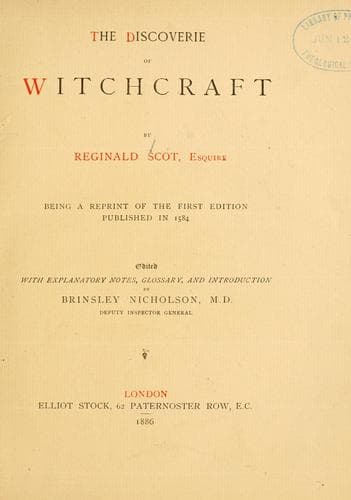
Demonology -- Early works to 1800; Magic -- Early works to 1800; Witchcraft -- Early works to 1800
And although some saie that the divell is the witches instrument, to
bring hir purposes and practises to passe: yet others saie that she is
his instrument, to execute his pleasure in anie thing, and therefore
to be executed. But then (me thinks) she should be injuriouslie dealt
withall, and put to death for anothers offense: for actions are not
judged by instrumentall causes; neither dooth the end and purpose
of that which is done, depend upon the meane instrument. Finallie,
if the witch doo it not, why should the witch die for it? But they
saie that witches are persuaded, and thinke, that they doo indeed
those mischeefs; and have a will to performe that which the divell
committeth: and that therefore they are worthie to die. By which reason
everie one should be executed, that wisheth evill to his neighbor,
&c. But if the will should be punished by man, according to the
offense against God, we should be driven by thousands at once to the
slaughterhouse or butcherie. For whosoever loatheth correction shall
die. And who should escape execution, if this lothsomnesse (I saie)
should extend to death by the civill lawes. Also the reward of sinne is
death. Howbeit, everie one that sinneth, is not to be put to death by
the magistrate. But (my Lord) it shalbe proved in my booke, and your
Lordship shall trie it to be true, as well here at home in your native
countrie, as also abrode in your severall circuits, that (besides
them that be _Venificæ_, which are plaine poisoners) there will be
found among our witches onelie two sorts; the one sort being such by
imputation, as so thought of by others (and these are abused, and not
abusors) the other by acceptation, as being willing so to be accompted
(and these be meere cousenors.)
♦Proverb. 5.♦
Calvine treating of these magicians, calleth them cousenors, saieng
that they use their juggling knacks onelie to amase or abuse the
people; or else for fame: but he might rather have said for gaine.
Erastus himselfe, being a principall writer in the behalfe of witches
omnipotencie, is forced to confesse, that these Greeke words, μαγία,
μαγγαγία, φαρμακία, are most commonlie put for illusion, false packing,
cousenage, fraud, knaverie and deceipt: and is further driven to saie,
that in ancient time, the learned were not so blockish, as not to see
that the promises of magicians and inchanters were false, and nothing
else but knaverie, cousenage, and old wives fables; and yet defendeth
he their flieng in the aire, their transferring of corne or grasse from
one feeld to another, &c.
♦_Instit. lib. 5. ca. 8. sect. 6._♦
♦_Item upon Deut. cap. 18._♦
♦_Lib. de lamiis, pag. 5._♦
Public-domain text, read in full here on John Shaqi.
Reviews
Reviews
No reviews yet
Be the first to share your thoughts on this work.
Join the Discussion
Join the discussion
Sign in to leave a comment or review.
Sign InorCreate an account