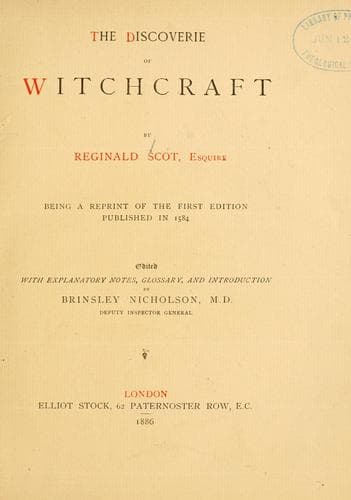
Demonology -- Early works to 1800; Magic -- Early works to 1800; Witchcraft -- Early works to 1800
The residue of 1. Sam. 28. expounded: wherein is declared how
cunninglie this witch brought Saule resolutelie to beleeve that she
raised Samuel, what words are used to colour the cousenage, & how all
might also be wrought by ventriloquie. p. 148.
Opinions of some learned men, that Samuel was indeed raised, not by the
witches art or power, but by the speciall miracle of God, that there
are no such visions in these our daies, and that our witches cannot
doo the like. pag. 151.
Of vaine apparitions, how people have beene brought to feare bugs,
which is partlie reformed by preaching of the gospel, the true effect
of Christes miracles. pag. 152.
Witches miracles cōpared to Christs, that God is the creator of al
things, of Apollo, and of his names and portraiture. pag. 154.
¶ _The eight Booke._
That miracles are ceased. 156.
That the gift of prophesie is ceased. Pag. 158.
That Oracles are ceased. pag. 160.
A tale written by manie grave authors, and beleeved by manie wise men
of the divels death. An other storie written by papists, and beleeved
of all catholikes, approoving the divels honestie, conscience, and
courtesie. pag. 162.
The judgments of the ancient fathers touching oracles, and their
abolishment, and that they be now transferred from Delphos to Rome.
p. 164.
Where and wherein couseners, witches, and preests were woont to give
oracles, and to worke their feats. pag. 165.
¶ _The ninth Booke._
The Hebrue word Kasam expounded, and how farre a Christian may
conjecture of things to come. Pag. 167.
Proofes by the old and new testament, that certaine observations of the
weather are lawfull. pag. 168.
That certeine observations are indifferent, certeine ridiculous, and
certeine impious, whence that cunning is derived of Apollo, and of
Aruspices. pag. 169.
The predictions of soothsaiers & lewd preests, the prognostications of
astronomers and physicians allowable, divine prophesies holie and
good. pag. 171.
The diversitie of true prophets, of Urim, and of the propheticall use
of the twelve pretious stones conteined therein, of the divine voice
called Eccho. pag. 172.
Public-domain text, read in full here on John Shaqi.
Reviews
Reviews
No reviews yet
Be the first to share your thoughts on this work.
Elsewhere in the archive
Join the Discussion
Join the discussion
Sign in to leave a comment or review.
Sign InorCreate an account