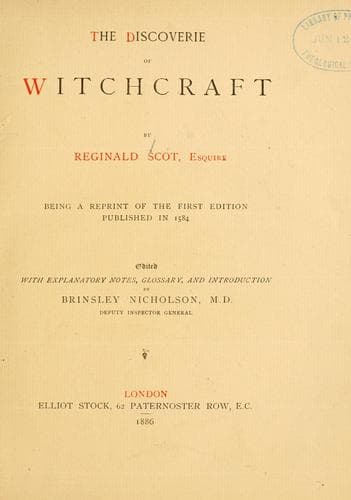
Demonology -- Early works to 1800; Magic -- Early works to 1800; Witchcraft -- Early works to 1800
Of prophesies conditionall: whereof the prophesies in the old testament
dee[*] intreat, and by whom they were published; witchmongers answers
to the objections against witches supernaturall actions. pag. 173.
What were the miracles expressed in the old testament, and what are
they in the new testament: and that we are not now to looke for anie
more miracles. pag. 175.
♦[*] [doe]♦
¶ _The tenth Booke._
The interpretation of the Hebrue word Onen, of the vanitie of dreames,
and divinations thereupon. Pag. 177.
Of divine, naturall, & casuall dreames, with the differing causes and
effects. pag. 178.
The opinion of divers old writers touching dreames, and how they varie
in noting the causes therof. p. 179.
Against interpretors of dreames, of the ordinarie cause of dreames,
Hemingius his opinion of diabolicall dreames, the interpretation of
dreames ceased. pag. 180.
That neither witches, nor anie other, can either by words or herbs,
thrust into the mind of a sleeping man, what cogitations or dreames
they list; and whence magicall dreames come. pag. 181.
How men have beene bewitched, cousened or abused by dreames to dig and
search for monie. pag. 182.
The art & order to be used in digging for monie, revealed by dreames,
how to procure pleasant dreames, of morning and midnight dreames.
p. 183.
Sundrie receipts & ointments, made and used for the transportation of
witches, and other miraculous effects: an instance thereof reported
and credited by some that are learned. pag. 184.
A confutation of the former follies, as well cōcerning ointments,
dreams, &c. as also of the assemblie of witches, and of their
consultations and bankets at sundrie places, and all in dreames.
pag. 185.
That most part of prophesies in the old testament were revealed in
dreams, that we are not now to looke for such revelations, of some
who have drempt of that which hath come to passe, that dreames proove
contrarie, Nebuchadnez zars[*] rule to know a true expositor of
dreames. pag. 187.
♦[*] [_sic_]♦
¶ _The eleventh Booke._
The Hebrue word Nahas expounded, of the art of augurie, who invented
it, how slovenlie a science it is: the multitude of sacrifices and
sacrificers of the heathen, and the causes thereof. Pag. 189.
Of the Jewes sacrifice to Moloch, a discourse thereupon, and of
Purgatorie. pag. 190.
Public-domain text, read in full here on John Shaqi.
Reviews
Reviews
No reviews yet
Be the first to share your thoughts on this work.
Elsewhere in the archive
Join the Discussion
Join the discussion
Sign in to leave a comment or review.
Sign InorCreate an account