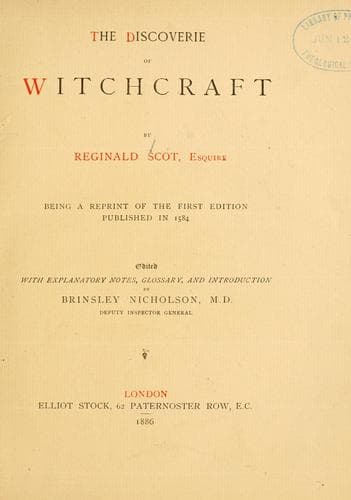
Demonology -- Early works to 1800; Magic -- Early works to 1800; Witchcraft -- Early works to 1800
The Cambals[*] crueltie, of popish sacrifices exceeding in tyrannie
the Jewes or Gentiles. pag. 191.
The superstition of the heathen about the element of fier, and how it
grew in such reverence among them, of their corruptions, and that
they had some inkling of the godlie fathers dooings in that behalfe.
pag. 191.
Of the Romane sacrifices, of the estimation they had of augurie, of the
lawe of the twelve tables. pag. 192.
Colleges of augurors, their office, their number, the signification
of augurie, that the practisers of that art were couseners, their
profession, their places of exercise, their apparell, their
superstition. pag. 193.
The times and seasons to exercise augurie, the maner and order thereof,
of the ceremonies thereunto belonging. pag. 195.
Upon what signes and tokens augurors did prognosticate, observations
touching the inward and outward parts of beasts, with notes of beasts
behaviour in the slaughterhouse. pag. 196.
A confutation of augurie, Plato his reverend opinion thereof, of
contrarie events, & false predictions. p. 196.
The cousening art of sortilege or lotarie, practiced especiallie by
Aegyptian vagabonds, of allowed lots, of Pythagoras his lot, &c.
pag. 197.
Of the Cabalisticall art, consisting of traditions and unwritten
verities learned without booke, and of the division thereof. cap. 198.
When, how, and in what sort sacrifices were first ordained, and how
they were prophaned, and how the pope corrupteth the sacraments of
Christ. pag. 200.
Of the objects whereupon the augurors used to prognosticate, with
certeine cautions and notes. pag. 201.
The division of augurie, persons admittable into the colleges of
augurie, of their superstition. pag. 202.
Of the common peoples fond and superstitious collections and
observations. pag. 203.
How old writers varie about the matter, the maner, and the meanes,
whereby things augurificall are mooved. pag. 205.
How ridiculous an art augurie is, how Cato mocked it, Aristotles
reason against it, fond collections of augurors, who allowed, and who
disallowed it. pag. 206.
Fond distinctions of the heathen writers, concerning augurie. pag. 208.
Of naturall and casuall augurie, the one allowed,and the other
disallowed. pag. 208.
Public-domain text, read in full here on John Shaqi.
Reviews
Reviews
No reviews yet
Be the first to share your thoughts on this work.
Elsewhere in the archive
Join the Discussion
Join the discussion
Sign in to leave a comment or review.
Sign InorCreate an account