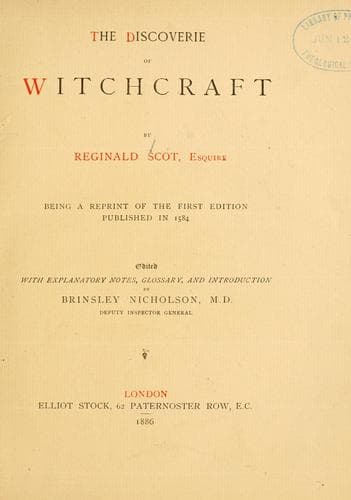
Demonology -- Early works to 1800; Magic -- Early works to 1800; Witchcraft -- Early works to 1800
The art alwaies presupposeth the power; so as, if they saie they can
doo this or that, they must shew how and by what meanes they doo it;
as neither the witches, nor the witchmoongers are able to doo. For
to everie action is required the facultie and abilitie of the agent
or dooer; the aptnes of the patient or subject; and a convenient and
possible application. Now the witches are mortall, and their power
dependeth upon the analogie and consonancie of their minds and bodies;
but with their minds they can but will and understand; and with their
bodies they can doo no more, but as the bounds and ends of terrene
sense will suffer: and therefore their power extendeth not to doo such
miracles, as surmounteth their owne sense, and the understanding of
others which are wiser than they; so as here wanteth the vertue and
power of the efficient. And in reason, there can be no more vertue in
the thing caused, than in the cause, or that which proceedeth of or
from the benefit of the cause. And we see, that ignorant and impotent
women, or witches, are the causes of incantations and charmes; wherein
we shall perceive there is none effect, if we will credit our owne
experience and sense unabused, the rules of philosophie, or the word of
God. For alas! What an unapt instrument is a toothles, old, impotent,
and unweldie woman to flie in the aier? Truelie, the divell little
needs such instruments to bring his purposes to passe.
♦_Aristot. de anima. lib. 2._ Acts. 8.♦
It is strange, that we should suppose, that such persons can worke
such feates: and it is more strange, that we will imagine that to
be possible to be doone by a witch, which to nature and sense is
impossible; speciallie when our neighbours life dependeth upon our
credulitie therein; and when we may see the defect of abilitie, which
alwaies is an impediment both to the act, and also to the presumption
thereof. And bicause there is nothing possible in lawe, that in nature
is impossible; therefore the judge dooth not attend or regard what
the accused man saith; or yet would doo: but what is prooved to have
beene committed, and naturallie falleth in mans power and will to
doo. For the lawe saith, that To will a thing unpossible, is a signe
of a mad man, or of a foole, upon whom no sentence or judgement taketh
hold. Furthermore, what Jurie will condemne, or what Judge will give
sentence or judgement against one for killing a man at _Berwicke_; when
they themselves, and manie other sawe that man at _London_, that verie
daie, wherein the murther was committed; yea though the partie confesse
himself guiltie therein, and twentie witnesses depose the same? But
in this case also I saie the judge is not to weigh their testimonie,
which is weakened by lawe; and the judges authoritie is to supplie the
imperfection of the case, and to mainteine the right and equitie of the
same.
♦Why shuld not the divell be as readie to helpe a theefe reallie as a
witch?♦
♦_L. multum. l. si quis alteri, vel sibi._♦
Public-domain text, read in full here on John Shaqi.
Reviews
Reviews
No reviews yet
Be the first to share your thoughts on this work.
Elsewhere in the archive
Join the Discussion
Join the discussion
Sign in to leave a comment or review.
Sign InorCreate an account