The discovery and decipherment of the trilingual cuneiform inscriptions — John Shaqi
The discovery and decipherment of the trilingual cuneiform inscriptionsBooth, Arthur John
History
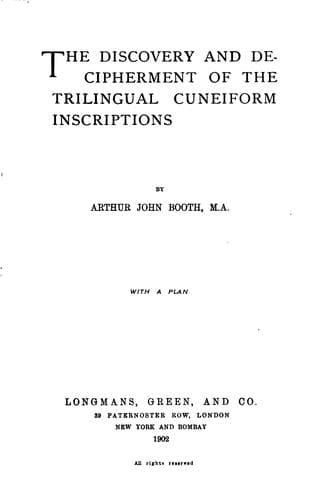
The discovery and decipherment of the trilingual cuneiform inscriptions
Booth, Arthur John
Achaemenian inscriptions; Cuneiform inscriptions
The missions took place chiefly in the reign of Shah Abbas (1587-1628),
a monarch whose alliance against the Turk was eagerly sought for by the
European powers. He had not only distinguished himself in the early part
of his reign by considerable military capacity, but had evinced a strong
desire to develop the commercial resources of his country. Indeed, he
was as much of a merchant as a soldier. He was the chief, if not the
sole, owner of the silk industry, and he sought to attract the merchants
of all nations by permitting the freest competition among them. He did
everything in his power to render the country agreeable to strangers. He
erected sumptuous caravansaries for their accommodation upon the road.
He made travelling even in remote districts absolutely safe, by the
slaughter, it was said, of twenty thousand robbers. He received men of
all nationalities and of the most diverse creeds with equal hospitality.
He even sought to attract skilled artisans from Europe to instruct his
subjects, and he caused his palaces to be decorated by foreign artists.
The period of his reign was peculiarly favourable for the execution of
his liberal projects. The Portuguese trade was carried on with great
success from Ormuz. About 1595 the Dutch made their first appearance in
the Indian Seas, and gave a great stimulus to competition. Nor were the
English merchants indifferent to the opening of a new market. So far back
as 1861 Antonie Jenkinson visited Persia with that object, but he was
not favourably received. In the first year of the seventeenth century,
John Mildenhall, accompanied by John Cartwright, a student of Magdalen,
renewed the overtures, and they found Shah Abbas even then well disposed
to cede a port on the Gulf. In 1609, Joseph Salbancke again reported
favourably of the commercial prospects if an English fleet could contend
successfully against the Portuguese and Dutch. At length the East India
Company, which was founded in 1600, succeeded in opening the trade in
1614, and from that year a British Resident was regularly established
at Ispahan. It thus happened that both political events and commercial
enterprise concurred at the same time to bring Persia into communication
with Europe, and a country that only a few years before was scarcely
known became the frequent resort of travellers.
Public-domain text, read in full here on John Shaqi.
Reviews
Reviews
No reviews yet
Be the first to share your thoughts on this work.
Join the Discussion
Join the discussion
Sign in to leave a comment or review.
Sign InorCreate an account