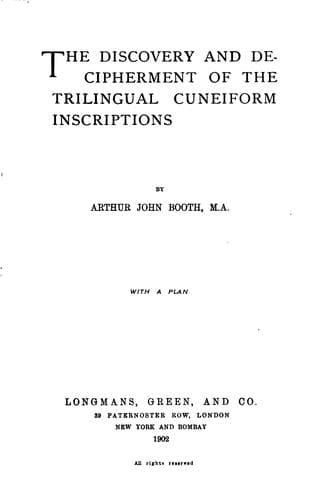
The discovery and decipherment of the trilingual cuneiform inscriptionsBooth, Arthur John
History
The discovery and decipherment of the trilingual cuneiform inscriptions
Booth, Arthur John
Achaemenian inscriptions; Cuneiform inscriptions
Down to the time we have now reached the progress made was disappointing.
We have seen that much speculation was indulged as to the affinity of
the language and the people to whom it should properly be attributed;
but very little knowledge of the language itself had been acquired.
Dr. Hincks had read forty-eight signs with sufficient correctness, and
De Saulcy thirty-one, out of the one hundred and eleven with which the
language is written; but both scholars were encumbered by the multitude
of unknown or erroneous values. In 1852, however, a considerable step
was made in advance. On July 3 of that year, Mr. Norris read a paper
to the Asiatic Society on the result of his study of the Median column
of the Behistun inscription with which Colonel Rawlinson had entrusted
him; but the essay did not appear in the Journal in its completed
form till 1855. The much greater diversity of material at his command
enabled him to dispose of many difficulties that had obstructed earlier
scholars. In the first place, he was able to increase the number of signs
from the eighty-two that had puzzled his predecessors to one hundred
and three, and to all of these he endeavoured to assign values. He was
successful with fifty-seven, and twenty-one others were sufficiently
correct for purposes of transliteration, making a total of seventy-eight
in addition to two determinatives. One other sign has not even yet been
satisfactorily settled,[652] and he still had twenty-four incorrect
values. Unlike many decipherers, however, he was able to distinguish
the gradations of certainty attaching to the values he assigned. Those
that appear in his list allied to any vowel other than _a_, _i_ or _u_
are to be regarded as questionable. He estimated their number with
tolerable accuracy at about twenty. He fully recognised the true syllabic
character of the language. ‘Each character,’ he says, ‘represents a
syllable which may be either a single vowel or a consonant and vowel, or
two consonants with a vowel between them.’[653] He has, however, given
six signs in his list a purely consonantal value, _m_, _r_, _s_ and _t_,
the two latter being each represented by two signs.[654] Four of these
are correct, but the second signs for s and t are both wrong. He limited
the vowels to _a_, _i_ and _u_, but he has also allowed _e_ to appear in
his list, because he found a sign in Median that corresponds exactly to
the Babylonian for that letter, and it is now admitted as correct. He
reckoned eleven initial consonantal sounds: they include the consonants
already named with the exception of _m_, together with _th_, _ch_, _p_,
_k_, _v_, _l_, _n_ and _y_. With these united to one of the three vowels
all the syllables in the language are formed. The double syllables
are composed of the same consonantal sounds (excluding _th_ and _y_),
separated by _a_. He did not consider that any of the signs represented
the union of two consonants separated by _i_ or _u_, an opinion that has
Public-domain text, read in full here on John Shaqi.
Reviews
Reviews
No reviews yet
Be the first to share your thoughts on this work.
Elsewhere in the archive
Join the Discussion
Join the discussion
Sign in to leave a comment or review.
Sign InorCreate an account