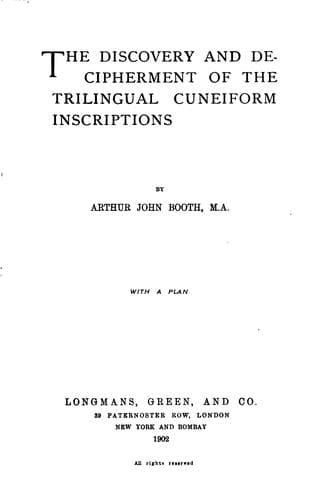
The discovery and decipherment of the trilingual cuneiform inscriptionsBooth, Arthur John
History
The discovery and decipherment of the trilingual cuneiform inscriptions
Booth, Arthur John
Achaemenian inscriptions; Cuneiform inscriptions
It is, in fact, in these essays that the first real progress in the
decipherment of Babylonian was made. In them Hincks laid the foundation
upon which all subsequent work was raised, a work to which he himself
contributed no small share.
The year 1847 was especially rich in contributions to the study. It
opened with the remarkable paper we have just reviewed; and during its
course Rawlinson expounded his views in the ‘Journal of the Asiatic
Society,’ Botta in the ‘Journal Asiatique,’ Longpérier in the ‘Revue
Archéologique.’ Löwenstern added another Memoir of greater value than
the first, and De Saulcy made his appearance in this field of inquiry by
a paper communicated to the Académie des Inscriptions, and by two essays
that have exposed him to much criticism.
Hincks, as we have seen, had worked exclusively upon the Persepolitan
and Babylonian texts; but the great discoveries of Botta and Layard
soon diverted attention to the more ample materials that were beginning
to pour in from Khorsabad and Nimrud. We have already alluded to the
enormous number of different signs that were found to be employed in
the Assyrian inscriptions—no less than six hundred and forty-two,
according to Botta’s computation. It seemed incredible that they could
all convey different shades of sound. Grotefend noticed that even in
the third Persepolitan some signs appeared to be interchangeable, and
therefore presumably of similar value; and this peculiarity became even
more noticeable in Babylonian.[785] Hincks, as we have seen, noticed
‘the equivalence to each other of different lapidary characters, which
are constantly transcribed by one and the same cursive character.’
In a paper read before the Académie des Inscriptions in 1845, Botta
explained that many Assyrian characters of very different form were
frequently substituted for one another, and the inference was that
there are several signs to express the same, or nearly the same, sound.
Rawlinson’s attention, up to the present, had been almost entirely fixed
upon the Persian column of the Behistun inscription, and his version
of it appeared early in 1847. He saw that it afforded the ‘only key to
the decipherment of the Babylonian alphabet.’[786] We have observed
that Grotefend found himself practically limited to four proper names;
Löwenstern had only twenty to work upon;[787] while Hincks and De
Saulcy, with the addition of the Naksh-i-Rustam inscription, had forty.
From the Behistun and other sources now available to Rawlinson, the
number gradually rose to ninety-four;[788] and with these before him, he
began to apply himself to ‘the determination of the phonetic powers of
the characters.’ Among the new names was that of Nebuchadnezzar, which he
at once recognised was the same as occurred so frequently on the bricks
at Hillah. This discovery was made quite independently of Dr. Hincks;
and Layard is inclined to think that, in actual date, the precedence is
Public-domain text, read in full here on John Shaqi.
Reviews
Reviews
No reviews yet
Be the first to share your thoughts on this work.
Elsewhere in the archive
Join the Discussion
Join the discussion
Sign in to leave a comment or review.
Sign InorCreate an account