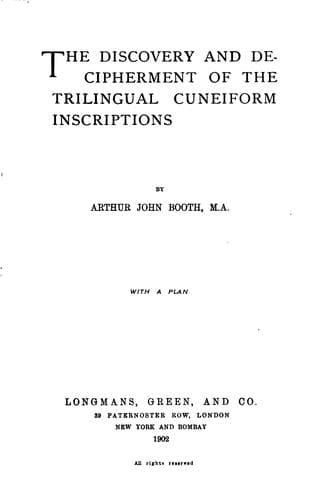
The discovery and decipherment of the trilingual cuneiform inscriptionsBooth, Arthur John
History
The discovery and decipherment of the trilingual cuneiform inscriptions
Booth, Arthur John
Achaemenian inscriptions; Cuneiform inscriptions
to Naksh-i-Rustam resulted in the earliest drawings we possess upon an
adequate scale of the façade of a tomb, and it was completed by a ground
plan of the interior.[114] He expressed his conviction that the third
tomb with the long cuneiform inscription was in all probability that
of Darius, an opinion afterwards proved to be correct.[115] The long
debate as to the nature of the enigmatical animals on the Great Porch at
Persepolis was still undecided. Even Mr. Morier adhered to the notion
that they were horses, but Porter’s keen eye at once identified them with
the bull, which subsequent discoveries at Nineveh has confirmed.[116]
He also showed that the capital of the columns was composed of two half
bulls, but he does not seem to have recorded that they are elsewhere
varied by half griffins.[117]
Porter had no doubt that the Takht-i-Jamshid represented the ruins of the
palaces of Persepolis, although the subject had not yet passed beyond
the region of controversy. He inclines, however, to the compromise
favoured by Niebuhr, and dwells upon the pontifical character of the
sovereign, especially after the death of Zoroaster, when, he says, Darius
assumed the title of Archimagus. He accepted Morier’s suggestion that
Murgab was the site of Pasargadae and its principal monument the tomb of
Cyrus.[118] He had a thorough belief in the decipherment of Grotefend.
He not only accepted his recognition of the names of Darius and Xerxes,
but he followed him when he traced their descent from Jamshid. That
hero was, he thought, none other than Shem, whom sacred writ planted
in that very region of Persia, and possibly Persepolis bore his name
from the very earliest ages.[119] Porter did not himself advance our
knowledge of the inscriptions. He copied the inscription at Murgab, but
that had been previously done by Morier and Ouseley, and, as he candidly
remarks, he ‘found that we all differed in some of the lines from each
other.’[120] He also copied a portion of the inscription (A) on the
sculptured staircase, of which Niebuhr had already given a satisfactory
rendering;[121] and finally he took the trouble to execute an extremely
imperfect copy of the four tablets of inscriptions on the south wall,
which had also been much better done by Niebuhr.[122]
Public-domain text, read in full here on John Shaqi.
Reviews
Reviews
No reviews yet
Be the first to share your thoughts on this work.
Elsewhere in the archive
Join the Discussion
Join the discussion
Sign in to leave a comment or review.
Sign InorCreate an account