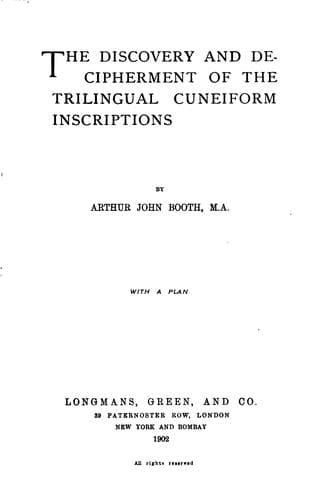
The discovery and decipherment of the trilingual cuneiform inscriptionsBooth, Arthur John
History
The discovery and decipherment of the trilingual cuneiform inscriptions
Booth, Arthur John
Achaemenian inscriptions; Cuneiform inscriptions
6. The central inscription of Artaxerxes Ochus on stairs to Palace of
Ochus[144]—now first taken.
7. His Seyid copied the three tablets of the inscription of Xerxes over
the colossal animals on the east walls of the Porch.[145] Mr. Rich was
unfortunately unable on account of giddiness to remain at a height; and
on this account he deputed the task to his Seyid, who had some experience
of the cuneiform letters found at Babylon. This inscription was now first
taken, but the copy turned out to be practically useless; and the first
adequate rendering was made by Westergaard.
Coming from Babylon, where all the inscriptions he had seen were
unilingual, he was much struck by the repetition of each inscription at
Persepolis in three distinct modes of writing. ‘Every inscription in
Persepolis,’ he says, ‘even the bits on the robes of the king, are in the
three kinds. When an inscription is round a door or window, the first
species is on the top, the second on the left hand running up, the third
on the right, running down. I speak as looking at the door.’ ‘If one
under the other, the first (or Zend) is always in the upper tablet; if
side by side over a figure, it is the one over the head of the king; if
on his robes, it is on the front fold; if on the face of a platform, it
is in the centre, with the figures on each side facing towards it.’ ‘The
other two species always preserve their order: the third (or Babylonian)
in the place of least consideration.’[146] He called special attention to
the inscriptions upon the tomb at Naksh-i-Rustam. ‘They are,’ he said,
‘the longest of all the cuneiform inscriptions I have ever seen. In
fact, there is a prodigious quantity of writing upon them, but so small
and so high up and so much worn that I should think it impossible to
copy them.’[147] He was neither surprised nor disappointed by his visit,
but the impression left was not one of unmixed admiration. The general
view presented by the ruins he declared to be grand; the colonnade to
be fine, and the execution and finish very beautiful; but he thought
the portals at the landing place were much too narrow, all the doors
too narrow and the windows too small, yet ‘formed of blocks that would
build a mole.’ There is no correspondence between the object and the
means, which gives to many parts of these remains, at least as they now
appear, rather a heavy, crowded and crushed effect, ‘proceeding from the
disproportionate application of vast materials, which is, after all, a
foolish ambition.’[148]
Public-domain text, read in full here on John Shaqi.
Reviews
Reviews
No reviews yet
Be the first to share your thoughts on this work.
Elsewhere in the archive
Join the Discussion
Join the discussion
Sign in to leave a comment or review.
Sign InorCreate an account