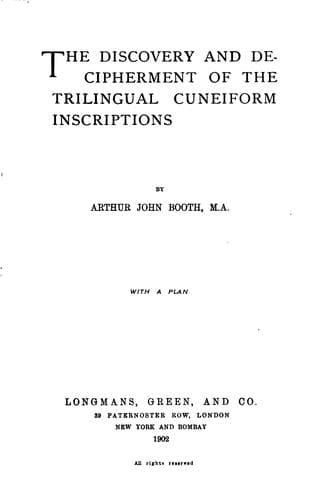
The discovery and decipherment of the trilingual cuneiform inscriptionsBooth, Arthur John
History
The discovery and decipherment of the trilingual cuneiform inscriptions
Booth, Arthur John
Achaemenian inscriptions; Cuneiform inscriptions
We have now come to the time when the enterprise of individual travellers
was about to be superseded by commissioners sent by foreign Governments
to collect information in an official capacity. We cannot say that the
general reader has cause to be thankful. We now part company with the
modest volume that could be purchased and handled with comparative ease.
In its place we have massive folios, which an enterprising student may
indeed find in the ‘large room’ of the British Museum, but which are
beyond the power of a private library to acquire. No one untainted by
African gold could contemplate their possession, and indeed it would
be necessary to build an addition to an ordinary house to find them
accommodation. They are not adapted for study, for they tax too severely
the physical endurance of the reader. The writer who is employed to fill
in the blanks between the magnificent illustrations, is probably sensible
of this, and one of them, M. Flandin, afterwards republished his text in
a more convenient form. These vast folios are designed, we should think,
mainly for the glorification of the Government who has paid for them,
and for the benefit of the various mechanical persons employed in their
fabrication. Sumptuously bound in red morocco, with richly gilt edges,
they serve only to be rolled into the room of a palace in order that the
pretty pictures that adorn them may be idly scanned amid the chatter of a
tea-table.
The first of these great compilations that comes under our notice was
made by Charles Texier, who had already gained fame and experience by
his ‘Description de l’Asie Mineure,’ published between 1838-48. He was
a Government Inspector of Public Works, and he subsequently became
Professor of Archæology at the Collège de France (1840). He obtained
a grant of 160,000 francs to enable him to publish his book, a sum
afterwards reduced to 100,000. He does not seem to have regarded this
measure with as much satisfaction as the reader, for he was compelled
upon this occasion to restrict his publication to only two folios; and
he complains that he had to suppress a considerable portion of his vast
collections. In 1839 he set out for Persia, and the account of his
travels was published by instalments between the years 1842 and 1852. In
1849 very few of the plates referring to Persepolis had appeared, and
no text,[167] but Fergusson was able to use a considerable part of the
drawings, in 1850, for his ‘Nineveh and Persepolis.’
Texier set out upon his enterprise, as Porter had done before, with a
desire to aim at the most scrupulous accuracy; but his fatal passion for
‘restorations’ has made sad havoc of his moral aspirations.
Public-domain text, read in full here on John Shaqi.
Reviews
Reviews
No reviews yet
Be the first to share your thoughts on this work.
Elsewhere in the archive
Join the Discussion
Join the discussion
Sign in to leave a comment or review.
Sign InorCreate an account