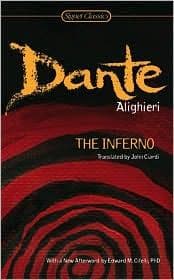
The Divine Comedy of Dante Alighieri: The InfernoDante Alighieri
ReligionJewish
The Divine Comedy of Dante Alighieri: The Inferno
Dante Alighieri
Epic poetry, Italian -- Translations into English; Hell; Italian poetry -- To 1400 -- Translations into English
[620] _His heaving throat_: In Purgatory Dante is known for a mortal by
his casting a shadow. Here he is known to be of flesh and blood by the
act of respiration; yet, as appears from line 113, the shades, too,
breathe as well as perform other functions of living bodies. At least
they seem so to do, but this is all only in appearance. They only seem
to be flesh and blood, having no weight, casting no shadow, and drawing
breath in a way of their own. Dante, as has been said (_Inf._ vi. 36),
is hard put to it to make them subject to corporal pains and yet be only
shadows.
[621] _Merry Friars_: Knights of the Order of Saint Mary, instituted by
Urban IV. in 1261. Whether the name of Frati Godenti which they here
bear was one of reproach or was simply descriptive of the easy rule
under which they lived, is not known. Married men might, under certain
conditions, enter the Order. The members were to hold themselves aloof
from public office, and were to devote themselves to the defence of the
weak and the promotion of justice and religion. The two monkish
cavaliers of the text were in 1266 brought to Florence as Podestas, the
Pope himself having urged them to go. There is much uncertainty as to
the part they played in Florence, but none as to the fact of their rule
having been highly distasteful to the Florentines, or as to the other
fact, that in Florence they grew wealthy. The Podesta, or chief
magistrate, was always a well-born foreigner. Probably some monkish rule
or custom forbade either Catalano or Loderingo to leave the monastery
singly.
[622] _Gardingo_: A quarter of Florence, in which many palaces were
destroyed about the time of the Podestaship of the Frati.
[623] _One man as victim_: _St. John_ xi. 50. Caiaphas and Annas, with
the Scribes and Pharisees who persecuted Jesus to the death, are the
vilest hypocrites of all. They lie naked across the path, unburdened by
the leaden cloak, it is true, but only that they may feel the more
keenly the weight of the punishment of all the hypocrites of the world.
[624] _Virgil_: On Virgil's earlier journey through Inferno Caiaphas and
the others were not here, and he wonders as at something out of a world
to him unknown.
[625] _On the right_: As they are moving round the Bolgia to the left,
the rocky barrier between them and the Seventh Bolgia is on their right.
[626] _We, both of us_: Dante, still in the body, as well as Virgil, the
shade.
[627] _The encircling wall_: That which encloses all the Malebolge.
[628] _He warned us_: Malacoda (_Inf._ xxi. 109) had assured him that
the next rib of rock ran unbroken across all the Bolgias, but it too,
like all the other bridges, proves to have been, at the time of the
earthquake, shattered where it crossed this gulf of the hypocrites. The
earthquake told most on this Bolgia, because the death of Christ and the
attendant earthquake were, in a sense, caused by the hypocrisy of
Caiaphas and the rest.
Public-domain text, read in full here on John Shaqi.
Reviews
Reviews
No reviews yet
Be the first to share your thoughts on this work.
Elsewhere in the archive
Join the Discussion
Join the discussion
Sign in to leave a comment or review.
Sign InorCreate an account