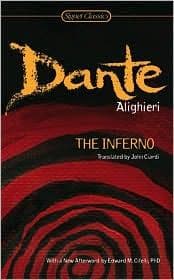
The Divine Comedy of Dante Alighieri: The InfernoDante Alighieri
ReligionJewish
The Divine Comedy of Dante Alighieri: The Inferno
Dante Alighieri
Epic poetry, Italian -- Translations into English; Hell; Italian poetry -- To 1400 -- Translations into English
[664] _The forms, etc._: The word _form_ is here to be taken in its
scholastic sense of _virtus formativa_, the inherited power of modifying
matter into an organised body. 'This, united to the divinely implanted
spark of reason,' says Philalethes, 'constitutes, on Dante's system, a
human soul. Even after death this power continues to be an essential
constituent of the soul, and constructs out of the elements what seems
to be a body. Here the sinners exchange the matter they have thus made
their own, each retaining, however, his proper plastic energy as part of
his soul.' Dante in his _Convito_ (iii. 2) says that 'the human soul is
the noblest form of all that are made under the heavens, receiving more
of the Divine nature than any other.'
[665] _The smoke has pause_: The sinners have robbed one another of all
they can lose. In the punishment is mirrored the sin that plunged them
here.
[666] _The novel theme_: He has lingered longer than usual on this
Bolgia, and pleads wonder of what he saw in excuse either of his
prolixity or of some of the details of his description. The expression
is perhaps one of feigned humility, to balance his recent boast of
excelling Ovid and Lucan in inventive power.
[667] _Gaville_: The other, and the only one of those five Florentine
thieves not yet named in the text, is he who came at first in the form
of a little black snake, and who has now assumed the shape of Buoso. In
reality he is Francesco Cavalcanti, who was slain by the people of
Gaville in the upper Valdarno. Many of them were in their turn
slaughtered in revenge by the Cavalcanti and their associates. It should
be remarked that some of these five Florentines were of one party, some
of the other. It is also noteworthy that Dante recruits his thieves as
he did his usurers from the great Florentine families.--As the 'shifting
and changing' of this rubbish is apt to be found confusing, the
following may be useful to some readers:--There first came on the scene
Agnello, Buoso, and Puccio. Cianfa, in the shape of a six-footed
serpent, comes and throws himself on Agnello, and then, grown
incorporate in a new strange monster, two in one, they disappear. Buoso
is next wounded by Francesco, and they exchange members and bodies. Only
Puccio remains unchanged.
CANTO XXVI.
Public-domain text, read in full here on John Shaqi.
Reviews
Reviews
No reviews yet
Be the first to share your thoughts on this work.
Elsewhere in the archive
Join the Discussion
Join the discussion
Sign in to leave a comment or review.
Sign InorCreate an account