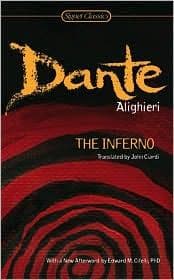
The Divine Comedy of Dante Alighieri: The InfernoDante Alighieri
ReligionJewish
The Divine Comedy of Dante Alighieri: The Inferno
Dante Alighieri
Epic poetry, Italian -- Translations into English; Hell; Italian poetry -- To 1400 -- Translations into English
[749] _The scab, etc._: As if by an infernal alchemy the matter of the
shadowy bodies of these sinners is changed into one loathsome form or
another.
[750] _To all eternity_: This may seem a stroke of sarcasm, but is not.
Himself a shade, Virgil cannot, like Dante, promise to refresh the
memory of the shades on earth, and can only wish for them some slight
alleviation of their suffering.
[751] _An Aretine_: Called Griffolino, and burned at Florence or Siena
on a charge of heresy. Albert of Siena is said to have been a relative,
some say the natural son, of the Bishop of Siena. A man of the name
figures as hero in some of Sacchetti's novels, always in a ridiculous
light. There seems to be no authentic testimony regarding the incident
in the text.
[752] _Dædalus_: Who escaped on wings of his invention from the Cretan
Labyrinth he had made and lost himself in.
[753] _The Sienese_: The comparison of these to the French would have
the more cogency as Siena boasted of having been founded by the Gauls.
'That vain people,' says Dante of the Sienese in the _Purgatory_ (xiii.
151). Among their neighbours they still bear the reputation of
light-headedness; also, it ought to be added, of great urbanity.
[754] _The Stricca_: The exception in his favour is ironical, as is that
of all the others mentioned.
[755] _Nicholas_: 'The lavish custom of the clove' which he invented is
variously described. I have chosen the version which makes it consist of
stuffing pheasants with cloves, then very costly.
[756] _The club_: The commentators tell that the two young Sienese
nobles above mentioned were members of a society formed for the purpose
of living luxuriously together. Twelve of them contributed a fund of
above two hundred thousand gold florins; they built a great palace and
furnished it magnificently, and launched out into every other sort of
extravagance with such assiduity that in a few months their capital was
gone. As that amounted to more than a hundred thousand pounds of our
money, equal in those days to a million or two, the story must be held
to savour of romance. That Dante refers to a prodigal's club that
actually existed some time before he wrote we cannot doubt. But it seems
uncertain, to say the least, whether the sonnets addressed by the Tuscan
poet Folgore da Gemignano to a jovial crew in Siena can be taken as
having been inspired by the club Dante speaks of. A translation of them
is given by Mr. Rossetti in his _Circle of Dante_. (See Mr. Symonds's
_Renaissance_, vol. iv. page 54, _note_, for doubts as to the date of
Folgore.)--_Caccia d' Ascian_: Whose short and merry club life cost him
his estates near Siena.
[757] _The Abbagliato_: Nothing is known, though a great deal is
guessed, about this member of the club. It is enough to know that,
having a scant supply of wit, he spent it freely.
Public-domain text, read in full here on John Shaqi.
Reviews
Reviews
No reviews yet
Be the first to share your thoughts on this work.
Elsewhere in the archive
Join the Discussion
Join the discussion
Sign in to leave a comment or review.
Sign InorCreate an account