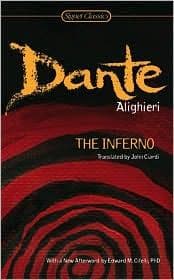
The Divine Comedy of Dante Alighieri: The Inferno — John Shaqi
The Divine Comedy of Dante Alighieri: The InfernoDante Alighieri
ReligionJewish
The Divine Comedy of Dante Alighieri: The Inferno
Dante Alighieri
Epic poetry, Italian -- Translations into English; Hell; Italian poetry -- To 1400 -- Translations into English
It may be owing to the free use of personification and symbol in the
_Vita Nuova_ that some critics, while not denying the existence of a
real Beatrice, have held that she is introduced only to help out an
allegory, and that, under the veil of love for her, the poet would
express his youthful passion for truth. Others, going to the opposite
extreme, are found wondering why he never sought, or, seeking, failed to
win, the hand of Beatrice. To those who would refine the Beatrice of the
early work into a being as purely allegorical as she of the _Comedy_, it
may be conceded that the _Vita Nuova_ is not so much the history of a
first love as of the new emotional and intellectual life to which a
first love, as Dante experienced it, opens the door. Out of the
incidents of their intercourse he chooses only such as serve for motives
to the joys and sorrows of the passionate aspiring soul. On the other
hand, they who seek reasons why Dante did not marry Beatrice have this
to justify their curiosity, that she did marry another man. But her
husband was one of the rich and powerful Bardi; and her father was so
wealthy that after providing for his children he could endow a hospital
in Florence. The marriage was doubtless arranged as a matter of family
convenience, due regard being had to her dower and her husband's
fortune; and we may assume that when Dante, too, was married later on,
his wife was found for him by the good offices of his friends.[40] Our
manners as regards these things are not those of the Italy of the
thirteenth century. It may safely be said that Dante never dreamed of
Beatrice for his wife; that the expectation of wedding her would have
sealed his lips from uttering to the world any word of his love; and
that she would have lost something in his esteem if, out of love for
him, she had refused the man her father chose for her.
We must not seek in the _Vita Nuova_ what it does not profess to give.
There was a real Beatrice Portinari, to a careless glance perhaps not
differing much from other Florentine ladies of her age and condition;
but her we do not find in Dante's pages. These are devoted to a record
of the dreams and visions, the new thoughts and feelings of which she
was the occasion or the object. He worshipped at a distance, and in a
single glance found reward enough for months of adoration; he read all
heaven into a smile. So high strung is the narrative, that did we come
on any hint of loving dalliance it would jar with all the rest She is
always at a distance from him, less a woman than an angel.
Public-domain text, read in full here on John Shaqi.
Reviews
Reviews
No reviews yet
Be the first to share your thoughts on this work.
Join the Discussion
Join the discussion
Sign in to leave a comment or review.
Sign InorCreate an account