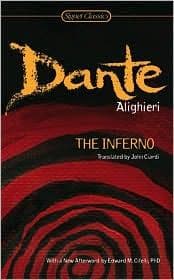
The Divine Comedy of Dante Alighieri: The InfernoDante Alighieri
ReligionJewish
The Divine Comedy of Dante Alighieri: The Inferno
Dante Alighieri
Epic poetry, Italian -- Translations into English; Hell; Italian poetry -- To 1400 -- Translations into English
[107] 'O ye, who have hitherto been following me in some small
craft, ... put not further to sea, lest, losing sight of me, you lose
yourselves' (_Parad._ ii. 1). But, to tell the truth, Dante is never so
weak as a poet as when he is most the philosopher or the theologian.
The following list of books more or less known to him is not given as
complete:--The Vulgate, beginning with St. Jerome's Prologue; Aristotle,
through the Latin translation then in vogue; Averroes, etc.; Thomas
Aquinas and the other Schoolmen; much of the Civil and Canon law;
Boethius; Homer only in scraps, through Aristotle, etc.; Virgil, Cicero
in part, Livy, Horace, Ovid, Terence, Lucan, and Statius; the works of
Brunetto Latini; the poetical literature of Provence, France, and Italy,
including the Arthurian Romances--the favourite reading of the Italian
nobles, and the tales of Charlemagne and his Peers--equally in favour
with the common people. There is little reason to suppose that among the
treatises of a scientific and quasi-scientific kind that he fell in
with, and of which he was an eager student, were included the works of
Roger Bacon. These there was a conspiracy among priests and schoolmen to
keep buried. Dante seems to have set little store on ecclesiastical
legends of wonder; at least he gives them a wide berth in his works.
[108] In the notes to Fraticelli's _Vita di Dante_ (Florence 1861) are
given copies of documents relating to the property of the Alighieri, and
of Dante in particular. In 1343 his son Jacopo, by payment of a small
fine, recovered vineyards and farms that had been his father's.--Notes
to Chap. iii. Fraticelli's admirable Life is now in many respects out of
date. He accepts, _e.g._, Dino Compagni as an authority, and believes in
the romantic story of the letter of Fra Ilario.
[109] The details are given by Witte, _Dante-Forschungen_, vol ii. p.
61. The amount borrowed by Dante and his brother (and a friend) comes to
nearly a thousand gold florins. Witte takes this as equivalent to 37,000
francs, _i.e._ nearly £1500. But the florin being the eighth of an
ounce, or about ten shillings' worth of gold, a thousand florins would
be equal only to £500--representing, of course, an immensely greater sum
now-a-days.
[110] _Purg._ viii. 76.
[111] See in Scartazzini, _Dante Alighieri_, 1879, page 552, extract
from the will of her mother Maria Donati, dated February 1314. Many of
these Florentine dates are subject to correction, the year being usually
counted from Lady-Day. 'In 1880 a document was discovered which proves
Gemma to have been engaged in a law-suit in 1332.--_Il Propugnatore_,
xiii^a. 156,'--Scheffer-Boichorst, _Aus Dantes Verbannung_, page 213.
[112] _Purg._ xxiv. 37.
[113] _Inf._ xxi. 40.
Public-domain text, read in full here on John Shaqi.
Reviews
Reviews
No reviews yet
Be the first to share your thoughts on this work.
Elsewhere in the archive
Join the Discussion
Join the discussion
Sign in to leave a comment or review.
Sign InorCreate an account