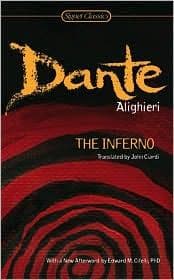
The Divine Comedy of Dante Alighieri: The InfernoDante Alighieri
ReligionJewish
The Divine Comedy of Dante Alighieri: The Inferno
Dante Alighieri
Epic poetry, Italian -- Translations into English; Hell; Italian poetry -- To 1400 -- Translations into English
A subject worthy of Giotto's pencil, and one likely to be offered to him
if he was then in Florence, we have therefore found in this visit of the
Duke and the Cardinal. But that Giotto was in Florence at that time is
certain. He painted a portrait[158] of the Duke in the Palace of the
Signory; and through that prince, as Vasari tells, he was invited by
King Robert to go down to work in Naples. All this, in the absence of
evidence of any value in favour of another date, makes it, at the very
least, highly probable that the fresco was a work of 1326 or 1327.
In 1326 Dante had been dead for five years. The grudge his
fellow-townsmen had nourished against him for so long was now worn out.
We know that very soon after his death Florence began to be proud of
him; and even such of his old enemies as still survived would be willing
that Giotto should set him in a place of honour among the great
Florentines who help to fill the fresco of the Paradise. That he was
already dead would be no hindrance to his finding room alongside of
Charles of Calabria; for the age was wisely tolerant of such
anachronisms.[159] Had Dante been still living the painter would have
been less at liberty to create, out of the records he doubtless
possessed of the features of the friend who had paid him beforehand with
one immortal line, the face which, as we look into it, we feel to be a
glorified transcript of what it was in the flesh. It is the face of one
who has wellnigh forgotten his earthly life, instead of having the worst
of it still before him; of one who, from that troubled Italy which like
his own Sapia he knew but as a pilgrim, has passed to the 'true city,'
of which he remains for evermore a citizen--the city faintly imaged by
Giotto upon the chapel wall.
FOOTNOTES:
[142] It is best known, and can now be judged of only through the
lithograph after a tracing made by Mr. Seymour Kirkup before it was
restored and ruined: published by the Arundel Society.
[143] Antonio Pucci, born in 1300, in his _Centiloquio_, describes the
figure of Dante as being clothed in blood-red. Philip Villani also
mentions it. He wrote towards the close of the fourteenth century;
Vasari towards the middle of the sixteenth.
[144] In the Munich collection of drawings, and ascribed to Masaccio,
but with how much reason I do not know.
[145] Painted by Domenico Michelino in 1465, after a sketch by Alessio
Baldovinetto.
[146] 'Wearing over the long hair of the Frenchmen of the period a
coroneted cap.'--Crowe and Cavalcaselle, _History of Painting in Italy_
(1864), i. 264.
[147] Vol. i. p. 269.
[148] The Priorate was the highest office to which a citizen could
aspire, but by no means the highest in Florence.
[149] I suppose the meaning is 'immediately previous.'
[150] John Villani, _Cronica_, viii. 40 and 49; and Perrens, _Hist. de
Florence_, under date of 1301. Charles entered Florence on the 1st of
November of that year, and left it in the following April.
Public-domain text, read in full here on John Shaqi.
Reviews
Reviews
No reviews yet
Be the first to share your thoughts on this work.
Elsewhere in the archive
Join the Discussion
Join the discussion
Sign in to leave a comment or review.
Sign InorCreate an account