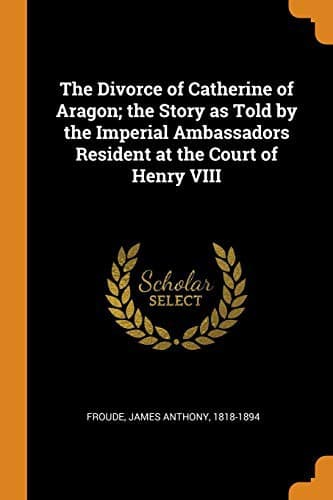
The Divorce of Catherine of Aragon: The Story as Told by the Imperial Ambassadors Resident at the Court of Henry VIII — John Shaqi
The Divorce of Catherine of Aragon: The Story as Told by the Imperial Ambassadors Resident at the Court of Henry VIIIFroude, James Anthony
History
The Divorce of Catherine of Aragon: The Story as Told by the Imperial Ambassadors Resident at the Court of Henry VIII
Froude, James Anthony
Catharine, of Aragon, Queen, consort of Henry VIII, King of England, 1485-1536 -- Divorce; Divorce -- Great Britain -- History -- 16th century; Great Britain -- History -- Henry VIII, 1509-1547 -- Biography; Great Britain -- Kings and rulers -- Biography; Henry VIII, King of England, 1491-1547 -- Di
Granting that Henry VIII. was, as Dickens said of him, "a spot of blood
and grease" on the page of English history, the contemporary generation of
Englishmen must have been fit subjects of such a sovereign. Every country,
says Carlyle, gets as good a government as it deserves. The England of the
Cromwells and the Cranmers, the Howards and the Fitzwilliams, the
Wriothesleys and the Pagets, seems to have been made of baser materials
than any land of which mankind has preserved a record. Roman Catholics may
fairly plead that out of such a race no spiritual reform is likely to have
arisen which could benefit any human soul. Of all the arguments which can
be alleged for the return of England to the ancient fold, this is surely
the most powerful.
Yet England shows no intention of returning. History may say what it
pleases, yet England remains tenacious of the liberties which were then
won for us, and unconscious of the disgrace attaching to them;
unconscious, also, that the version of the story which it accepts contains
anything which requires explanation. The legislation of Henry VIII., his
Privy Council, and his parliaments is the Magna Charta of the modern
world. The Act of Appeals and the Act of Supremacy asserted the national
independence, and repudiated the interference of foreign bishop, prince,
or potentate within the limits of the English empire. The clergy had held
for many centuries an _imperium in imperio_. Subject themselves to no law
but their own, they had asserted an irresponsible jurisdiction over the
souls and bodies of the people. The Act for the submission of these
persons reduced them to the common condition of subjects under the control
of the law. Popes were no longer allowed to dispense with ordinary
obligations. Clerical privileges were abolished. The spiritual courts,
with their intolerable varieties of iniquity, were swept away, or coerced
within rational limits. The religious houses were suppressed, their
enormous wealth was applied for the defence of the realm, and the worse
than Augean dunghill of abuses was cleared out with resolute hand. These
great results were accomplished in the face of papal curses, in defiance
of superstitious terrors, so despicable when bravely confronted, so
terrible while the spectre of supernatural power was still unexorcised; in
the face, too, of earthly perils which might make stout hearts shake, of
an infuriated priesthood stirring the people into rebellion, of an
exasperated Catholic Europe threatening fire and sword in the name of the
Pope. These were distinguished achievements, not likely to have been done
at all by an infamous prince and infamous ministers; yet done so well that
their work is incorporated in the constitution almost in the form in which
they left it; and this mighty revolution, the greatest and most
far-reaching in modern times, was accomplished without a civil war, by
firmness of hand, by the action of Parliament, and a resolute enforcement
of the law.
Reviews
Reviews
No reviews yet
Be the first to share your thoughts on this work.
Join the Discussion
Join the discussion
Sign in to leave a comment or review.
Sign InorCreate an account