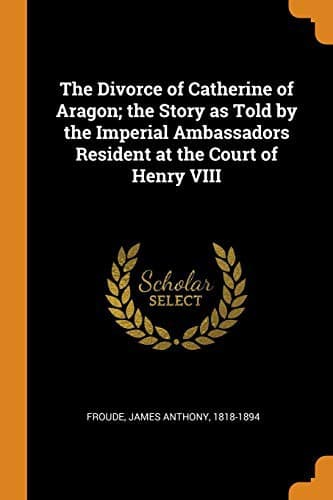
The Divorce of Catherine of Aragon: The Story as Told by the Imperial Ambassadors Resident at the Court of Henry VIII — John Shaqi
The Divorce of Catherine of Aragon: The Story as Told by the Imperial Ambassadors Resident at the Court of Henry VIIIFroude, James Anthony
History
The Divorce of Catherine of Aragon: The Story as Told by the Imperial Ambassadors Resident at the Court of Henry VIII
Froude, James Anthony
Catharine, of Aragon, Queen, consort of Henry VIII, King of England, 1485-1536 -- Divorce; Divorce -- Great Britain -- History -- 16th century; Great Britain -- History -- Henry VIII, 1509-1547 -- Biography; Great Britain -- Kings and rulers -- Biography; Henry VIII, King of England, 1491-1547 -- Di
That the Pope would be willing, if he dared, to gratify Henry at Charles's
expense was only too likely. The German Lutherans and the German Emperor
were at the moment his most dangerous enemies. France and England were the
only Powers who seemed willing to assist him, and a week before the
meeting of Wolsey's court he had experienced in the most terrible form
what the imperial hostility might bring upon him. On the 7th of that same
month of May the army of the Duke of Bourbon had taken Rome by storm. The
city was given up to pillage. Reverend cardinals were dragged through the
streets on mules' backs, dishonoured and mutilated. Convents of nuns were
abandoned to the licentious soldiery. The horrors of the capture may have
been exaggerated, but it is quite certain that to holy things or holy
persons no respect was paid, and that the atrocities which in those days
were usually perpetrated in stormed towns were on this occasion eminently
conspicuous. The unfortunate Pope, shut up in the Castle of St. Angelo,
looked down from its battlements upon scenes so dreadful that it must have
appeared as if the Papacy and the Church itself had been overtaken by the
final judgment. We regard the Spaniards as a nation of bigots, we consider
it impossible that the countrymen of Charles and Philip could have been
animated by any such bitterness against the centre of Catholic
Christendom. Charles himself is not likely to have intended the
humiliation of the Holy See. But Clement had reason for his misgivings,
and Wolsey's policy was not without excuse. Lope de Soria was Charles's
Minister at Genoa, and Lope de Soria's opinions, freely uttered, may have
been shared by many a Catholic besides himself. On the 25th of May, a
fortnight after the storm, he wrote to his master the following noticeable
letter:--
"The sack of Rome must be regarded as a visitation from God, who permits
his servant the Emperor to teach his Vicar on earth and other Christian
princes that their wicked purposes shall be defeated, the unjust wars
which they have raised shall cease, peace be restored to Christendom, the
faith be exalted, and heresy extirpated.... Should the Emperor think that
the Church of God is not what it ought to be, and that the Pope's temporal
power emboldens him to promote war among Christian princes, I cannot but
remind your Majesty that it will not be a sin, but a meritorious action,
to reform the Church; so that the Pope's authority be confined exclusively
to his own spiritual affairs, and temporal affairs to be left to Caesar,
since by right what is God's belongs to God, and what is Caesar's to Caesar.
I have been twenty-eight years in Italy, and I have observed that the
Popes have been the sole cause of all the wars and miseries during that
time. Your Imperial Majesty, as Supreme Lord on earth, is bound to apply a
remedy to that evil."[10]
Reviews
Reviews
No reviews yet
Be the first to share your thoughts on this work.
Join the Discussion
Join the discussion
Sign in to leave a comment or review.
Sign InorCreate an account