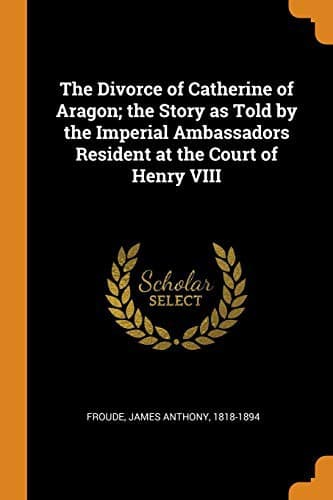
The Divorce of Catherine of Aragon: The Story as Told by the Imperial Ambassadors Resident at the Court of Henry VIII — John Shaqi
The Divorce of Catherine of Aragon: The Story as Told by the Imperial Ambassadors Resident at the Court of Henry VIIIFroude, James Anthony
History
The Divorce of Catherine of Aragon: The Story as Told by the Imperial Ambassadors Resident at the Court of Henry VIII
Froude, James Anthony
Catharine, of Aragon, Queen, consort of Henry VIII, King of England, 1485-1536 -- Divorce; Divorce -- Great Britain -- History -- 16th century; Great Britain -- History -- Henry VIII, 1509-1547 -- Biography; Great Britain -- Kings and rulers -- Biography; Henry VIII, King of England, 1491-1547 -- Di
For the ministers of great countries deliberately to sell themselves to
foreign princes was the custom of the age. The measure of public virtue
which such a custom indicates was not exalted; and among the changes
introduced by the Reformation the abolition or suspension of it was not
the least beneficial. Thomas Cromwell, when he came to power, set the
example of refusal, and corruption of public men on a scale so
scandalously enormous was no more heard of. Gold, however, had flowed in
upon Wolsey in such enormous streams and from so many sources that the
Emperor's munificence and attention failed to tempt him. On reaching Paris
he found Francis bent upon war, and willing to promise anything for
Henry's assistance. The belief at the French Court was that the Emperor,
hearing that the Churches of England and France meant to decline from
their obedience to the Roman Communion, would carry the Pope to Spain;
that Clement would probably be poisoned there, and the Apostolic See would
be established permanently in the Peninsula.[20] Wolsey himself wrote
this, and believed it, or desired Henry to believe it, proving the extreme
uncertainty among the best-informed of contemporary politicians as to the
probable issue of the capture of Rome. The French Cardinals drew and sent
an address to the Pope, intimating that as long as he was in confinement
they could accept no act of his as lawful, and would not obey it. Wolsey
signed at the head of them. The Cardinals Salviati, Bourbon, Lorraine, and
the Chancellor Cardinal of Sens, signed after him.[21] The first stroke in
the game had been won by Wolsey. Had the Pope recalled his powers as
legate, an immediate schism might have followed. But a more fatal blow had
been prepared for him by his master in England. Trusting to the Cardinal's
promises that the Pope would make no difficulty about the divorce, Henry
had considered himself at liberty to choose a successor to Catherine. He
had suffered once in having allowed politics to select a wife for him.
This time he intended to be guided by his own inclination. When Elizabeth
afterwards wished to marry Leicester, Lord Sussex said she had better fix
after her own liking; there would be the better chance of the heir that
her realm was looking for. Her father fixed also after his liking in
selecting Elizabeth's mother.
Public-domain text, read in full here on John Shaqi.
Reviews
Reviews
No reviews yet
Be the first to share your thoughts on this work.
Join the Discussion
Join the discussion
Sign in to leave a comment or review.
Sign InorCreate an account