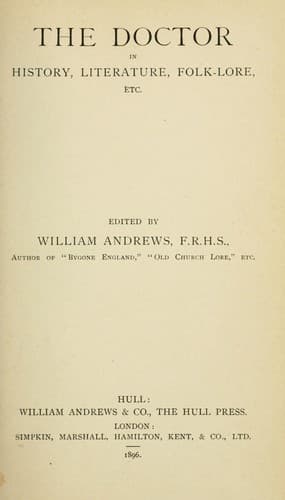
The Doctor in History, Literature, Folk-Lore, Etc.
History
The Doctor in History, Literature, Folk-Lore, Etc.
Literature and medicine; Physicians; Physicians in literature
In the preceding pages we have referred to "touch pieces," and it will not
be without interest to direct attention to some of the more notable
examples. A small sum of money was given by Edward I., and it has been
suggested that it was probably presented in the form of alms. Henry VII.
gave a small gold coin known as the angel noble. It was of about six
shillings and eight pence in value, and was a current coin of the period,
and the smallest gold coin issued. On one side of the coin was a figure of
the angel Michael overcoming the dragon, and on the other a ship on the
waves. During the residence of Charles II. on the continent, those who
visited him to receive the royal rite had to give him gold, but after the
Restoration, "touch-pieces" were made expressly for presentation at the
healings. They were small gold medals resembling angels, but they were not
equal in value to the angels previously given. However they met a want
when gold was in great demand. James II. had two kinds of touch pieces,
one of gold and the other of silver, but they were not half the size of
those given by Charles II. Queen Anne gave a touch-piece a little larger
than that of James II. The touch-piece presented by this Queen to Dr.
Johnson may, with other specimens, be seen in the British Museum.
[Illustration: TOUCH-PIECE OF ANNE (GOLD).]
In a carefully-compiled article in the _Archaeological Journal_, vol. x.,
p. 187-211, will be found some interesting particulars of touch-pieces,
and to it we are indebted for the few details we have given bearing on
this part of our subject.
Visiting Patients.
The doctor made his daily rounds, before the reign of Charles II., on
horseback, sitting sideways on foot-clothes. He must have cut an
undignified figure as he rode through the streets of London and our chief
towns.
A change came after the Restoration, and we meet with the physicians
making their visits in a carriage and pair. It seems that increased fees
were expected with the introduction of the carriage. A curious note
appears on this subject in _Lex Talionis_. "For there must now be a little
coach and two horses," says the author, "and, being thus attended,
half-a-piece their usual fee is but ill taken, and popped into their left
pocket, and possibly may cause the patient to send for his worship twice
before he will come again in the hazard of another angel." The carriage
was popular, and physicians vied with each other in making the greatest
display.
In the days of Queen Anne, a doctor would even drive half-a-dozen horses
attached to his chariot, and not fewer than four was the general rule.
In our own time the doctor's carriage and pair is to be seen in all
directions. It is now driven for use and not for display as in the days of
Queen Anne.
We have seen the bicycle used by doctors of good standing, and we predict
the time is not far distant when it will be more generally ridden by
members of the medical profession.
Assaying Meat and Drink.
Public-domain text, read in full here on John Shaqi.
The Doctor in History, Literature, Folk-Lore, Etc. — John Shaqi
Reviews
Reviews
No reviews yet
Be the first to share your thoughts on this work.
Join the Discussion
Join the discussion
Sign in to leave a comment or review.
Sign InorCreate an account