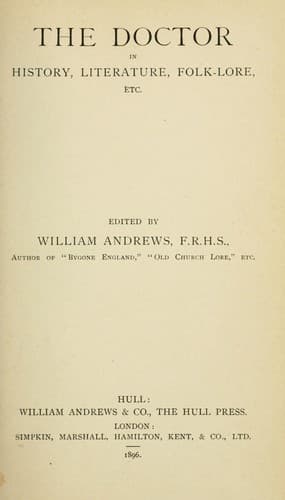
The Doctor in History, Literature, Folk-Lore, Etc.
History
The Doctor in History, Literature, Folk-Lore, Etc.
Literature and medicine; Physicians; Physicians in literature
During the time that this guard, which consists
of the tallest and stoutest men that can be found in all England, being
carefully selected for this service, were bringing dinner, twelve trumpets
and two kettle-drums made the hall ring for half-an-hour together. At the
end of the ceremonial, a number of unmarried ladies appeared, who, with
particular solemnity, lifted the meat off the table and conveyed it into
the Queen's inner and more private chamber, where, after she had chosen
for herself, the rest goes to the ladies of the Court."
[Illustration: ASSAYING WINE.]
Drink as well as food had to be assayed twice, once in the buttery and
again in the hall. The butler drank of the wine in the buttery, and then
handed it to the cup-bearer in a covered vessel. When he arrived at the
hall, he removed the lid of the cup, and poured into the inverted cover a
little of the wine, and drank it under the eye of his master. We give an
illustration, reproduced from an ancient manuscript, of an assayer tasting
wine. The middle of the twelfth century is most probably the period
represented.
In the ancient assay cup, it is related on reliable authority, a charm was
attached to a chain of gold, or embedded in the bottom of the vessel.
This was generally a valuable carbuncle or a piece of tusk of a narwhal,
usually regarded as the horn of the unicorn, and which was believed to
have the power of neutralising or even detecting the presence of poison.
Edward IV. presented to the ambassadors of Charles of Burgundy a costly
assay cup of gold, ornamented with pearls and a great sapphire, and, to
use the words of an old writer, "in the myddes of the cuppe ys a grete
pece of a Vnicornes horne."
The water used for washing the hands of the great had to be tasted by the
yeoman who placed it on the table, to prove that no poison was contained
in the fluid. This ceremony had to be performed in the presence of an
assayer.
The Gold-headed Cane.
BY TOM ROBINSON, M.D.
The stick takes many forms. It is the sceptre of kings, the club of a
police constable, the baton of a field marshal. The mace is but a stick of
office, being ornamental and merely symbolical.
In history we may go back to the pilgrim's staff, which was four feet
long, and hollow at the top to carry away relics from the Holy Land. It
was also used to carry contraband goods, such as seeds, or silk-worms'
eggs, which the Chinese, Turks, or Greeks forbade to be exported. It is
occasionally used for eluding the customs now. Some people smuggle
diamonds into the United States in that way.
Prometheus' reed, or marthex, in which he conveyed fire to "wretched
mortals," as Aeschylus tells us, is a well-known fable.
An enormous amount of interest centres around the walking stick, and there
are few families in which we do not find an old stick handed down
generation after generation. Such an inheritance was at one time a common
possession of those who belonged to the medical profession.
Public-domain text, read in full here on John Shaqi.
Reviews
Reviews
No reviews yet
Be the first to share your thoughts on this work.
Join the Discussion
Join the discussion
Sign in to leave a comment or review.
Sign InorCreate an account