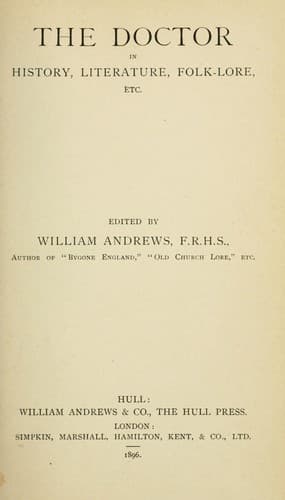
The Doctor in History, Literature, Folk-Lore, Etc. — John Shaqi
The Doctor in History, Literature, Folk-Lore, Etc.
History
The Doctor in History, Literature, Folk-Lore, Etc.
Literature and medicine; Physicians; Physicians in literature
An idea is in the air that the study of science has a tendency to make men
sceptical. This is an error. For surely the study of Nature in any of its
manifold aspects has a direct tendency to lead us into the inscrutable.
Amongst those who demonstrate the ennobling influence of science let us
only name Boyle, Bacon, Kepler, and Newton. If we would select a few names
from the number of medical celebrities of the past who have felt this
elevating influence, the following will readily occur to us, Linacre,
Sydenham, Brodie, Astley Cooper, Graves Watson, and Abernethy. The latter,
who is chiefly remembered as a coiner of quaint sayings and personal
originality, had, notwithstanding his biting wit, a deep sense of the
nobility and the sacredness of his calling, as the following extract from
a lecture which he delivered at the Royal College of Surgeons will prove.
He says:--"When we examine our bodies we see an assemblance of organs
formed of what we call matter, but when we examine our minds, we feel that
there is something sensitive and intelligible which inhabits our bodies.
We naturally believe in the existence of a first cause. We feel our own
free agency. We distinguish right and wrong. We feel as if we were
responsible for our conduct, and the belief in a future state seems
indigenous to the mind of man."
The noiseless tread of time will cause many doctors whose names are now
household words to be forgotten, but we may rest assured that the wreath
of memory will cluster round the brows of these grand, noble workers in
the field of medicine who have shown by their daily life that they never
flinched from the arduous duties, aye and the dangers of their profession,
but steadfastly plodded on. Originality, integrity, and honesty are
attributes which grace the life of any man, and although the history of
medicine claims no monopoly of these virtues, for they serve all men
alike, yet they are the handmaids of greatness; without them no human
being will ever win that true success which enables us to look back upon
such lives and say, "Here are examples which show us the possibilities of
the race." Doctors ought to be great burden lifters. Their mission is to
carry into the chamber of disease--and even of death itself--that calm
courage, that buoyant hope, which has around it a halo of sympathy and of
encouragement.
Public-domain text, read in full here on John Shaqi.
Reviews
Reviews
No reviews yet
Be the first to share your thoughts on this work.
Join the Discussion
Join the discussion
Sign in to leave a comment or review.
Sign InorCreate an account