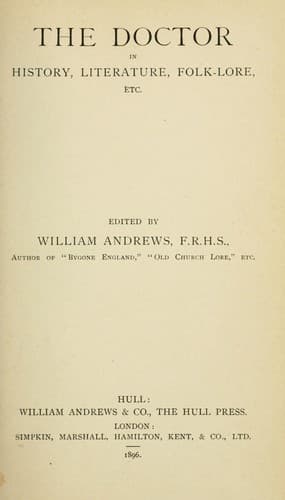
The Doctor in History, Literature, Folk-Lore, Etc.
History
The Doctor in History, Literature, Folk-Lore, Etc.
Literature and medicine; Physicians; Physicians in literature
In Tibet, for example, when all ordinary remedies have failed, the Lamas
make a dummy to represent the sick person, and they adorn the image with
trinkets. By ceremonies and prayers the sickness of the patient is laid
upon the dummy, after which it is taken out and burned, the Lamas
appropriating the ornaments as a reward. Sir Walter Scott tells of a
similar case which occurred in Scotland. Lady Katharine Fowlis made a
model in clay of a person whom she wished to afflict, and shot at the
image in the hope that the wound would be transferred to the real person.
We have only to turn to Scott's "Demonology and Witchcraft" to find
hundreds of instances of the unshaken belief of the Highlanders in mystic
potions, pills, drugs, and drops; and not even wholesale burnings of the
dealers in white magic could induce the people to forsake their
superstitions. Bessie Dunlop told the Court, before which she was
arraigned, of the magic elixirs given to her by Thome Reid, who had been
killed in battle centuries before, but had appeared to her as an
apparition, and begged her to fly with him to Elf-land. By means of his
medicines she cured the most stubborn diseases, obtained the reputation of
a wise woman, and grew so rich that the eye of the law was drawn upon her,
and, after her confession was made, she was ordered to be burnt. As Scott
said, in one of his chapters, the Scottish law did not acquit those who
accomplished even praiseworthy actions, and "the proprietor of a patent
medicine who should in those days have attested his having wrought such
miracles as we see sometimes advertised might have forfeited his life."
Public-domain text, read in full here on John Shaqi.
Reviews
Reviews
No reviews yet
Be the first to share your thoughts on this work.
Join the Discussion
Join the discussion
Sign in to leave a comment or review.
Sign InorCreate an account