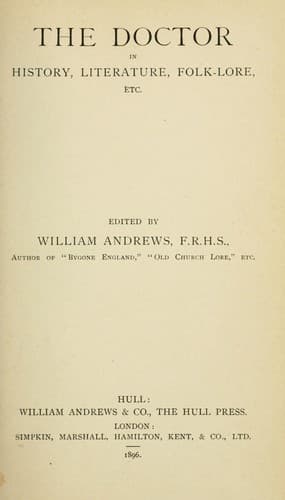
The Doctor in History, Literature, Folk-Lore, Etc. — John Shaqi
The Doctor in History, Literature, Folk-Lore, Etc.
History
The Doctor in History, Literature, Folk-Lore, Etc.
Literature and medicine; Physicians; Physicians in literature
When Coleridge was a little boy at the Blue Coat School, he relates in his
Table Talk, there was a "charm for one's foot when asleep," which he
believed had been in the school since its foundation in the time of King
Edward VI. Its potency lay in the words--
"Crosses three we make to ease us,
Two for the thieves, and one for Christ Jesus."
The same charm served for cramp in the leg, and Coleridge quaintly adds:
"Really, upon getting out of bed, where the cramp most frequently
occurred, pressing the sole of the foot on the cold floor, and then
repeating this charm, I can safely affirm that I do not remember an
instance in which the cramp did not go away in a few seconds." Charms like
this, by which a simple method of cure is invested with marvel, are common
enough among primitive races, and not infrequently provide the key to the
solution of the mystery of the magician's triumph. The cunning leaders,
priests, or medicine-men of ignorant nations maintain their ascendency by
ascribing to miracle the simplest feats they perform.
The superstitious red man is completely at the mercy of the medicine-man
who claims to possess supernatural powers, and who assumes the ability to
work marvellous cures by magic. Each North American Indian carries with
him a medicine bag obtained under very curious circumstances. When he is
approaching manhood he sets forth in search of the patent drug which is to
shield him from all danger, and act as an all-powerful talisman. He lies
down alone in the woods upon a litter of twigs, eats and drinks nothing
for several days, and at last falls asleep from sheer exhaustion. Then he
dreams--or should do so--and whatever bird, or beast, or reptile, forms
the subject of his dream, he must seek as his medicine. He goes forth upon
the quest directly his strength has returned, and when he has discovered
the animal of his vision, he turns its skin into a pouch, and wears it
ever afterwards round his neck. In peace or war he will never part with
this talisman; it is the treasure of his life, a sacred possession, a
charm against all maladies, and a protection from foes. It is scarcely
necessary to add, after this, that the medicine-man of the tribe is held
in highest honour, and regarded as a worker of veritable miracles. All
things are possible to him. By his prayers, his rites, and his
incantations he causes the sun to shine, the rain to descend, the rivers
to deepen, the plants to thrive. A traveller tells us that a drought had
withered the maize fields, and the medicine-man was sent for to compel
the rain to fall. On the first day one Wah-ku, or the Shield, came to the
front, but failed; so did Om-pah, or the Elk. On succeeding days another
was tried, but without success; but at last recourse was made to
Wak-a-dah-ha-Ku, or the White Buffalo Hair, who possessed a shield
coloured with red lightnings, and carried an arrow in his hand. Much was
expected of him, and the people were not disappointed. "Taking his station
Public-domain text, read in full here on John Shaqi.
Reviews
Reviews
No reviews yet
Be the first to share your thoughts on this work.
Join the Discussion
Join the discussion
Sign in to leave a comment or review.
Sign InorCreate an account