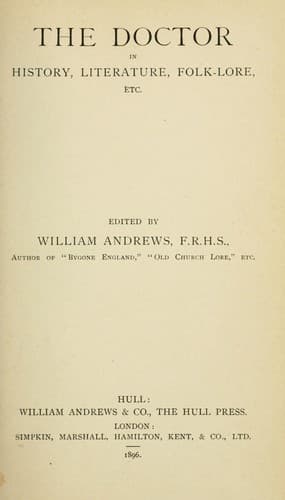
The Doctor in History, Literature, Folk-Lore, Etc.
History
The Doctor in History, Literature, Folk-Lore, Etc.
Literature and medicine; Physicians; Physicians in literature
result of this _Archaeus_, a spiritual activity, working in a very
mysteriously complicated way, for both evil and good. It has been said
that he was one of Lord Bacon's disciples, but for that assertion there
certainly is no sufficient foundation, for Bacon, if a mystic by
inclination, was logical in reasoning. In England Van Helmont had an
English follower in the person of another physician, Dr. Fludd, a disciple
of the famous inventor of the camera obscura, and conjecturally the first
photographer. His grand quack remedy was "the powder of sympathy," which
was the "sword-salve" of Paracelsus (composed of moss taken from the skull
of a gibbetted murderer, of warm human blood, human suet, linseed oil,
turpentine, etc.). This was applied, not to the wound, but to the sword
that inflicted it, kept "in a cool place!" Certain plants pulled up with
the left hand were regarded as a sure remedy in fever cases, but the
gatherer, while gathering, was not to look behind, for that deprived the
plants of their medicinal value.
Amongst other physicians of Shakespeare's century was Mr. Valentine
Greatrake, who came to London from Ireland, where his supposed magical
cures had been awakening a great sensation. He hired a large house in
Lincoln's Inn Fields, to which vast crowds of patients of all kinds and
conditions crowded daily, all clamouring to be cured. He received them in
their order, says an eye-witness, with "a grave and simple countenence."
For, as Shakespeare wrote, "Thus credulous fools are caught." ("Comedy of
Errors," 1, 2.) Greatrake (afterwards executed for high treason) asserted
that every diseased person was possessed by a devil, and that by his
prayers and laying on of hands the devil could be cast out. Lord Conway
sent for him to cure an incurable disease from which his wife was
suffering, and even some of the most learned and eminent people of the
time were amongst his patrons. St. Evremond wrote, "You can hardly imagine
what a reputation he gained in a short time. Catholics and Protestants
visited him from every part, all believing that power from heaven was in
his hands."
In an Act of Parliament which was passed in the year 1511, we read, in its
preamble, that "the science and cunning of Physic and Surgery" was
exercised by "a great multitude of ignorant persons, of whom the greater
part have no manner of insight in the same, nor in any other kind of
learning--some also can read no letters in the book--so far forth that
common artificers, as smiths, weavers, and women, boldly and accostumably
took upon them great cures, and things of great difficulty, in which they
partly used sorceries and witchcraft, and partly supplied such medicines
unto the diseased as are very noisome, and nothing meet therefore; to the
high displeasure of God," etc.
A large number of the pretended remedies thus used in medical practice are
clearly traceable back to the ancient Magi, who were professors of
medicine, as well as priests and astrologers.
Public-domain text, read in full here on John Shaqi.
Reviews
Reviews
No reviews yet
Be the first to share your thoughts on this work.
Join the Discussion
Join the discussion
Sign in to leave a comment or review.
Sign InorCreate an account