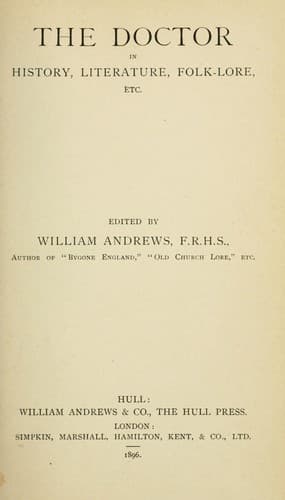
The Doctor in History, Literature, Folk-Lore, Etc.
History
The Doctor in History, Literature, Folk-Lore, Etc.
Literature and medicine; Physicians; Physicians in literature
In the reign of Henry VIII. an enactment as follows was in force:--"No
person using any shaving or barbery in London shall occupy any surgery,
letting of blood, or other matter, except of drawing teeth." Laws were
made, but they could not be, or at all events were not, enforced. Disputes
were frequent. The barbers acted often as surgeons, and the surgeons
increased their income by the use of the razor and shears. At this period
vigorous attempts were made to confine each to their legitimate work.
The barber's pole, it is said, owes its origin to the barber-surgeons.
Much has been written on this topic, but we believe that the following are
the facts of the matter. We know that in the days of old bleeding was a
frequent occurrence, and during the operation the patient used to grasp a
staff, stick, or pole which the barber-surgeon kept ready for use, and
round it was bound a supply of bandages for tying the arm of the patient.
The pole, when not in use, was hung at the door as a sign. In course of
time a painted pole was displayed instead of that used in the operation.
Lord Thurlow addressing the House of Lords, July 17th, 1797, stated, "by a
statute, still in force, barbers and surgeons were each to use a pole [as
a sign]. The barbers were to have theirs blue and white, striped, with no
other appendage; but the surgeons', which was to be the same in other
respects, was likewise to have a gully-pot and a red rag, to denote the
particular nature of their vocations."
The Rev. J. L. Saywell has a note on bleeding in his "History and Annals
of Northallerton" (1885):--"Towards the early part of this century,"
observes Mr. Saywell, "a singular custom prevailed in the town and
neighbourhood of Northallerton (Yorkshire). In the spring of the year
nearly all the robust male adults, and occasionally females, repaired to a
surgeon to be bled, a process which they considered essentially conduced
to vigorous health." The charge for the operation was one shilling.
Parliament was petitioned, in 1542, praying that surgeons might be exempt
from bearing arms and serving on juries, and thus be enabled without
hindrance to attend to their professional duties. The request was granted,
and to the present time medical men enjoy the privileges granted so long
ago.
In 1745, the surgeons and the barbers separated by Act of Parliament. The
barber-surgeons lingered for a long time, the last in London, named
Middleditch, of Great Suffolk Street, in the Borough, only dying in 1821.
Mr. John Timbs, the popular writer, left on record that he had a vivid
recollection of Middleditch's dentistry.
Touching for the King's Evil.
BY WILLIAM ANDREWS, F.R.H.S.
The practice of touching for the cure of scrofula--a disease more
generally known as king's evil--prevailed for a long period in England.
Edward the Confessor who reigned from 1042 to 1066, appears to be the
first monarch in this country who employed this singular mode of
treatment.
Public-domain text, read in full here on John Shaqi.
Reviews
Reviews
No reviews yet
Be the first to share your thoughts on this work.
Join the Discussion
Join the discussion
Sign in to leave a comment or review.
Sign InorCreate an account