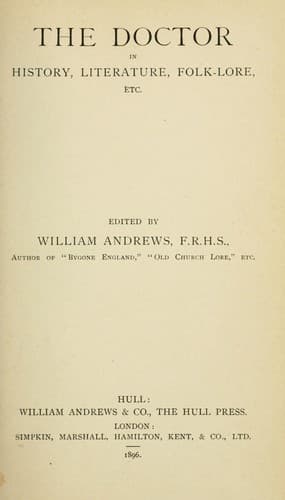
The Doctor in History, Literature, Folk-Lore, Etc.
History
The Doctor in History, Literature, Folk-Lore, Etc.
Literature and medicine; Physicians; Physicians in literature
There is another medical character in one of the Christmas stories which,
good as it is, might have been made better but for the extent to which the
exigencies of space limited the author in the development of character in
that class of stories. I mean Dr. Jeddler, the genial but mistaken father
of Grace and Marion, in "The Battle of Life." The doctor is "a great
philosopher, and the heart and mystery of his philosophy was to look upon
the world as a gigantic practical joke; as something too absurd to be
considered seriously by any practical man. His system of belief had been
in the beginning part and parcel of the battle ground on which he lived."
He is not of the cynical school, but a modern Democritus, whose
inclination to laugh at everything on the surface of the ocean of life was
irresistible, while there was nothing in the conditions of his existence
to suggest anything that was beneath. When he hears his daughters
conversing about their lovers, "his reflections as he looked after them,
and heard the purport of their discourse, were limited at first to certain
merry meditations on the folly of all loves and likings, and the idle
imposition practised on themselves by young people who believe for a
moment that there could be anything serious in such bubbles, and were
always deceived--always."
Dr. Jeddler is a widower; we are not told what his experiences of married
life had been. Had they been unhappy, one would suppose that he would have
been more disposed to be cynical and pessimistic than to regard life's
incidents as provocative of merriment, yet, if they had been happy, why
should he have regarded the engagement of Grace as an idle folly, a bubble
on life's surface, soon to burst? Dickens' explanation is, from this point
of view, scarcely satisfactory. "He was sorry," says the novelist, "for
her sake--sorry for them both--that life should be such a very ridiculous
business as it was. The doctor never dreamed of inquiring whether his
children, or either of them, helped in any way to make the scheme a
serious one. But then he was a philosopher. A kind and generous man by
nature, he had stumbled by chance over that common philosopher's stone
(much more easily discovered than the object of the alchemist's
researches) which sometimes trips up kind and generous men, and has the
fatal property of turning gold to dross, and every precious thing to poor
account."
But when sorrow had humbled the doctor's heart, he felt that the world in
which some love, deep-anchored, is the portion of every human creature,
was more serious than he had thought it, and understood "how such a trifle
as the absence of a little unit in the great absurd account had stricken
him to the ground." Then, when he and his daughters are again together in
the old home, and his arms are about them both, we find him acknowledging
that "It's a world full of hearts, and a serious world with all its
folly,--even with mine, which was enough to swamp the whole world."
Public-domain text, read in full here on John Shaqi.
Reviews
Reviews
No reviews yet
Be the first to share your thoughts on this work.
Join the Discussion
Join the discussion
Sign in to leave a comment or review.
Sign InorCreate an account