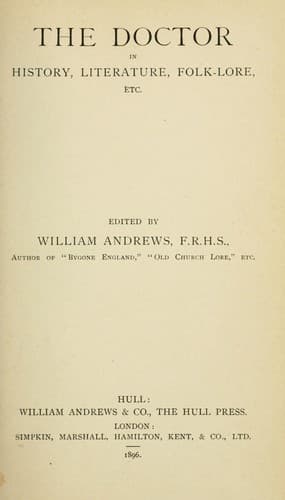
The Doctor in History, Literature, Folk-Lore, Etc.
History
The Doctor in History, Literature, Folk-Lore, Etc.
Literature and medicine; Physicians; Physicians in literature
It was about the time when the last of these advertisements appeared that
Jenner commenced his inquiries concerning the prophylactic virtues of
cow-pox, though nearly twenty years elapsed before they were sufficiently
advanced to enable him to make the results known. His idea of using
vaccine inoculation to bring about the total extinction of small pox was
scouted by those of his professional brethren to whom he mentioned it, and
we learn from one of his biographers that, at the outset, "both his own
observation and that of other medical men of his acquaintance proved to
him that what was commonly called cow-pox was not a certain preventive of
small-pox. But he ascertained by assiduous inquiry and personal
investigation that cows were liable to various kinds of eruption on their
teats, all capable of being communicated to the hands of the milkers; and
that such sores when so communicated were all called cow-pox." But when he
had traced out the nature of these various diseases, and ascertained which
of them possessed the protective virtue against small-pox, he was again
foiled by learning that in some cases when what he now called the true
cow-pox broke out among the cattle on a dairy farm, and had been
communicated to the milkers, they subsequently had small-pox. These
repeated failures perplexed him, but at the same time stimulated, instead
of discouraging him. He conceived the idea that the virus of cow-pox
might undergo some change which deprived it of its protective power, while
still enabling it to communicate a disease to human beings. Following up
the inquiry from this point, he at length discovered that the virus was
capable of imparting protection against small-pox only in a certain
condition of the pustule.
He was now prepared to submit his theory to the test of experiment, but it
was not until 1796 that he had the opportunity. A dairymaid, who had
contracted cow-pox from one of her employer's cows, afforded the matter,
and Jenner introduced it into two incisions in the arms of a boy about
eight years of age. The disease thus transferred ran its ordinary course
without any ill effects, and the boy was afterwards inoculated with the
virus of small pox, which produced no effect. The disappearance of the
cow-pox from the dairies in the neighbourhood of his country practice in
Gloucestershire prevented him from making further experiments; and when he
visited London for that purpose, he had the mortification of finding that
no one could be found who would consent to be operated upon. It was not
until 1798 that this obstacle was overcome, and then, the results of the
earlier experiments having been confirmed by a series of vaccinations,
followed by inoculation for small-pox several months afterwards without
effect, Jenner made his discovery public.
Public-domain text, read in full here on John Shaqi.
Reviews
Reviews
No reviews yet
Be the first to share your thoughts on this work.
Elsewhere in the archive
Join the Discussion
Join the discussion
Sign in to leave a comment or review.
Sign InorCreate an account