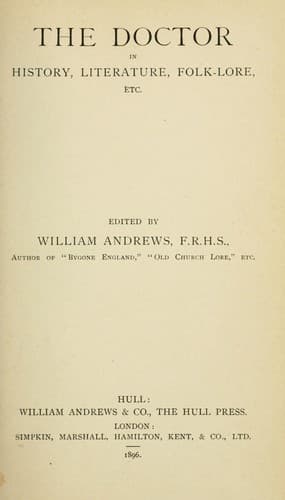
The Doctor in History, Literature, Folk-Lore, Etc.
History
The Doctor in History, Literature, Folk-Lore, Etc.
Literature and medicine; Physicians; Physicians in literature
In order to detain the men until the arrival of the police, the
demonstrator showed them a L50 note, observing that he must get it changed
for gold before he could pay them. Several constables were soon on the
spot, and the four men were arrested, and taken to the station-house in
Vine Street, Covent Garden. On being charged on suspicion with having
unlawful possession of a corpse, May said he had nothing to do with it,
and had merely accompanied Bishop. A similar statement was made by
Williams, and Bishop said he was only removing the corpse from St.
Thomas's Hospital to King's College. Shields, who was known as a porter,
said he was employed to carry the hamper, which he did in the exercise of
his vocation. They were all then removed to the cells.
The evidence given at the coroner's inquest by Partridge and two other
surgeons left no doubt that the unfortunate lad, respecting whose identity
there was no evidence, had been killed by a violent blow on the back of
the neck, which had affected the spinal cord. The four accused men were
present in custody during the inquiry, and Bishop, after reading a bill
relating to the murder, which was displayed on the wall of the room, was
heard by a constable to say, in a subdued tone, to May, "It was the blood
that sold us." Volunteering to give evidence, he said he got the corpse
from a grave, but declined to name the place whence he had got it,
alleging that the information would get into trouble two watchmen, who
had large families. May also made a voluntary statement, to the effect
that he got two "subjects" from the country, which he took first to
Grainger's theatre of anatomy, and afterwards to Guy's Hospital,
subsequently meeting Bishop, who promised him all he could get for a
"subject" above nine guineas if he would sell it for him. The inquest was
adjourned, and the police proceeded with their investigation.
The houses of Bishop and May had been promptly visited and searched by the
police, who found at the former's a sack, a large hamper, and a brad-awl,
the last showing recent bloodstains. At May's house in Dorset Street, New
Kent Road, they found a pair of breeches, stained with blood at the back.
On a second visit to Bishop's house the garden was dug over, and a jacket,
trousers, and a shirt found in one spot, and in another a coat, trousers,
a vest with blood on the collar and one shoulder, and a shirt with the
front torn. When the brad-awl was produced at Bow Street police-court, May
said, "That is the instrument I punched the teeth out with." Shields was
eventually discharged from custody, but the other three prisoners were
committed for trial on the capital charge.
Public-domain text, read in full here on John Shaqi.
Reviews
Reviews
No reviews yet
Be the first to share your thoughts on this work.
Elsewhere in the archive
Join the Discussion
Join the discussion
Sign in to leave a comment or review.
Sign InorCreate an account