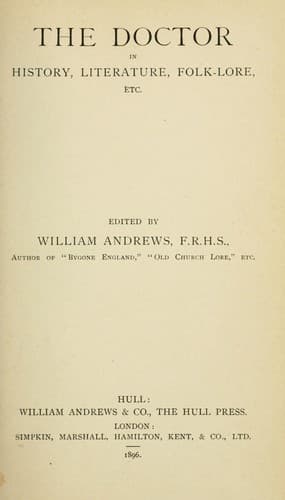
The Doctor in History, Literature, Folk-Lore, Etc.
History
The Doctor in History, Literature, Folk-Lore, Etc.
Literature and medicine; Physicians; Physicians in literature
The identity of the victim remained a mystery until the 19th of November,
a fortnight after the murder, when the corpse was recognised by a
foreigner named Brun as that of a boy named Carlo Ferrari, whom he had
brought from Italy two years before, but had not seen since July, 1830.
The boy picked up the means of living by exhibiting a tortoise and a pair
of white mice in the streets. He had been seen by several persons in or
near Nova Scotia Gardens on the 3rd of November, but he had not been seen
since, nor had he returned on that day to his miserable lodgings in
Charles Street, Drury Lane. The clothes found in Bishop's garden
corresponded with the description given of those worn by him when he was
last seen, and a little boy who played with Bishop's children stated that
they had, on the following day, shown him two white mice in a cage similar
to the one carried by Ferrari.
The incidents of the crime, as revealed from day to day, and the mystery
in which the identity of the victim was for some time veiled, created so
much excitement in the public mind, that when the prisoners were placed
in the dock at the Old Bailey, early in December, the court was crowded,
and a guinea each was paid for seats in the gallery, the occupants of
which, all fashionably dressed, as might be expected of those who could
afford to pay that price for the gratification of their love of the
sensational, had taken their seats the day before. Though the evidence was
but a recapitulation of the story told before in the police-court and the
inquest-room, it was listened to with the utmost avidity. The witnesses
for the defence were few, and their evidence valueless, except in the case
of May, for whom an _alibi_ was established in respect of the time between
the afternoon of the day preceding the murder and noon on the following
day. The prisoners were sentenced to death, but in May's case the sentence
was commuted into transportation for life. A sea-faring relative of mine,
who was second officer of the vessel in which May was sent out to Sydney,
described him as an athletic, wiry-looking man, with features expressive
of sternness, and a determined will, quite a different-looking man,
therefore, to his two companions in crime, who were duly hanged at
Newgate.
The crime of these men, and the deeds of Burke and Hare, created such a
scare, and exposed so vividly the temptation to murder afforded by the
prices paid by surgeons for "subjects," that the attention of parliament
was directed to the matter, and a Select Committee of the House of Commons
was appointed to inquire and report as to the facilities which might be
given for obtaining bodies for anatomical purposes in a legitimate manner.
Public-domain text, read in full here on John Shaqi.
Reviews
Reviews
No reviews yet
Be the first to share your thoughts on this work.
Elsewhere in the archive
Join the Discussion
Join the discussion
Sign in to leave a comment or review.
Sign InorCreate an account