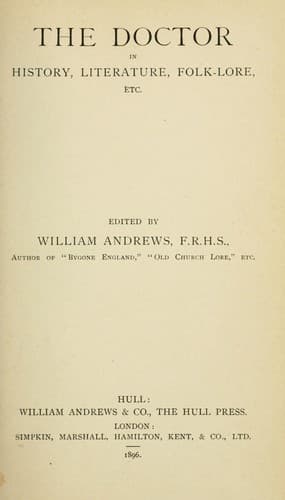
The Doctor in History, Literature, Folk-Lore, Etc.
History
The Doctor in History, Literature, Folk-Lore, Etc.
Literature and medicine; Physicians; Physicians in literature
These are not matters on which I have to dwell, but I think the present
work would be incomplete without a record of those men of original mind,
whose acute observation and unwearied investigations in the past have
indissolubly linked their names with discoveries which have revolutionised
the practice of both medicine and surgery.
In the opinion of Solomon, "there is nothing new under the sun;" and if
such was the case in his day, how much more of a verity must be the
truism in ours.
So the most startling and perfect revelation of any great fact in human
physiology may have been dimly perceptible to earlier intelligences
groping in the dark, faint adumbrations of which may fall on the sensorium
of the final discoverer, until a ray of divine light dispels the mists of
ages, and the man, developing his crude idea with infinite pains, realises
a great truth, and cries out "Eureka" to an astonished--and too often--an
unbelieving world.
Thus it may have been with the renowned practitioner, WILLIAM HARVEY, who
came into the world when all England was filled with alarms of an
"Invincible Spanish Armada," then preparing to devastate our shores and
spare neither man nor maid, babe nor mother. Yet the scare passed and
peace came, and the boy grew, until his educational course at Cambridge
ended, and his bias led him towards Padua, then the great seat of
academical and medical lore, and there he took his doctor's degree in
physic. With the prestige of Padua upon him, in 1607, when he was but
twenty years of age, he was elected Fellow of the College of Physicians
(founded by Dr. Linacre in the reign of Henry VII.), and in 1715, the man
of twenty-eight became their Anatomical Reader.
A noteworthy appointment this, since consequent study and investigation
led to the grand discovery that the heart--to speak unscientifically--was
a sort of muscular pumping-engine, sending the blood circulating along a
series of blood-vessels to every part of the system, changing in character
on its course until it returned to its centre, the seat of life, to be
pumped out afresh to circulate as before and do its appointed work.
In 1628, Harvey made his discovery known in a learned treatise "On the
circulation of the blood," and as may be supposed, his daring assertions
roused a violent spirit of opposition amongst his medical brethren, even
among those who began to feel the pulses of their patients for the first
time, and to comprehend _why_ there should be a fluttering or audible
beating under the sick one's ribs, and wherefore the fatal hemorrhage
following a sword-thrust or a gunshot wound.
In spite of opposition his teaching created a revolution in medical
practice. The discoverer was called before Charles I. and his Court to
demonstrate the action of the heart and subsidiary organs, in support of
his new doctrine.
Public-domain text, read in full here on John Shaqi.
Reviews
Reviews
No reviews yet
Be the first to share your thoughts on this work.
Elsewhere in the archive
Join the Discussion
Join the discussion
Sign in to leave a comment or review.
Sign InorCreate an account