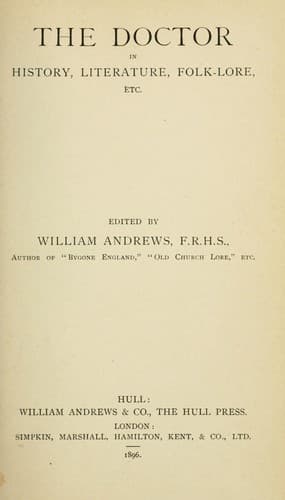
The Doctor in History, Literature, Folk-Lore, Etc.
History
The Doctor in History, Literature, Folk-Lore, Etc.
Literature and medicine; Physicians; Physicians in literature
Fresh honours fell upon him even when too old to bear the burden. And when
in the fulness of time, William Harvey, who had outlived three monarchs,
made his own exit under Cromwellian rule, he bequeathed infinitely more to
posterity in his invaluable discovery than can be summed up in the estate,
library, and museum now in the proud possession of the College of
Physicians. These are held by a mere body of men. The other has a
world-wide significance.
Yet, as in his life, even in his grave, detractors strove to dim the glory
of his important revelation, ascribing to the theological physician
Servetus, to Realdus Columbus, and to Andreas Caesalpinas, the credit of
prior discovery.
It remained for another learned physician, a century later, to deal with
these counter-claims, and whilst admitting their vague individual
conceptions of an elusive mystery, to establish once and for ever William
Harvey's inalienable right as sole discoverer.
This notable champion was JOHN FREIND, M.D., F.R.S., distinguished as the
Medical Historian, and Harveian lecturer to the College of Physicians, at
a time when he and his fellows shaved their heads and mounted Ramillies
wigs as outward guarantees for the profundity of wisdom they enshrined.
But apart from his flowing wig, or his defence of Harvey, or his learned
medical history, written in part when he was a prisoner in the Tower for
supposed complicity in the Atterbury Plot, or for skill in the treatment
of disease, John Freind had a pioneer's claim to distinction.
The doctor, strange to say, was a Member of Parliament, and on resuming
his seat on his release from incarceration, he brought before the House of
Commons, in 1725, a remarkable petition from the Royal College of
Physicians, to restrain "the pernicious use of spirituous liquors." And
though he might speak but as the mouthpiece of his brother Fellows, it
needed no small degree of courage to broach such a subject in those days
of general coarse indulgence among all classes; especially if his own
language was as direct and forcible as that of the petitioners.
Therefore, in his triple character as the historian of medicine, as the
champion of William Harvey, and as the foremost M.P. to advocate the
cause of temperance before our national legislative assembly, John Freind,
M.D., claims a niche in our Walhalla of notable old doctors.
Public-domain text, read in full here on John Shaqi.
Reviews
Reviews
No reviews yet
Be the first to share your thoughts on this work.
Elsewhere in the archive
Join the Discussion
Join the discussion
Sign in to leave a comment or review.
Sign InorCreate an account