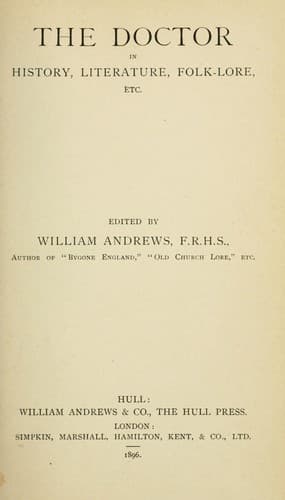
The Doctor in History, Literature, Folk-Lore, Etc.
History
The Doctor in History, Literature, Folk-Lore, Etc.
Literature and medicine; Physicians; Physicians in literature
Honours fell upon him thickly as they had fallen on his brother, alike
British and foreign, of which he took little heed, absorbed as he was in
the pursuit of knowledge, and its demonstration. His discoveries placed
him far ahead of the science of his time, though his courtly brother,
earlier in the field and first to leave it, ran him close. Indeed their
final quarrel and alienation arose out of a disputed claim to a certain
discovery in feminine physiology, brought before the Royal Society, a
quarrel which transferred William's museum to the University of Glasgow,
and excluded John from his will.
The so-called "Lyceum Medicum" in Leicester Square, became the home of the
"Society for the Improvement of Medical and Chirurgical Knowledge," and
the "Philosophical Transactions" of the Society testify to the genius and
untiring activity of its promoter. How he found time for his many written
essays and discourses on topics wide apart as "Gunshot-wounds" and "Teeth"
is a marvel. No wonder the frail human machine wore out so early. He had
worked when he should have rested, worked regardless of premonitions and
attacks John Hunter must have well understood, and died at last at
sixty-two, a victim of one of those fits of passion no man with a diseased
heart can indulge in safely.
Setting out originally from the tablet in Westminster Abbey to describe
what manner of man was the old doctor who lay beneath, it became
imperatively necessary to bracket the two brothers, John and William
Hunter, together, since, according to Sir B. W. Richardson, they were
"twins in science," if not in birth. Had not William already come to the
front when John sought him out, he could not have been his teacher, or
given his younger brother his first start in life, his introduction, or
his facilities for study. Then they worked together, became one in
anatomical discovery, in their zeal for collecting all that illustrated
their theories, all that was rare and curious, into unprecedented museums.
Yet how widely the personalities of the brothers differed. They both stood
out among contemporaries, yet William, with his slight form, mildly
refined face, set off by an unpretentious wig, and delicate hands, under
lace ruffles, and wide coat cuffs, a classical scholar, an antiquary, a
numismatist, as well as a naturalist,--Queen Charlotte's medical referee,
stepping out from his chariot, gold cane in hand, to visit his courtly
patients, was the very _beau ideal_ of a fashionable physician of that
day, one who shone in drawing-rooms as well as in the lecture-hall.
Blue-eyed John, with high cheek bones, broad, slightly receding forehead,
tangled red hair, and a shaggy mane of whisker that made his keen face a
triangle, tender of heart, yet brusque and coarse of speech, rough in
manner as in dress (with not a sign of frill or ruffle), despising
dilettante coteries, not squeamish in seeking "subjects," passionate and
Public-domain text, read in full here on John Shaqi.
Reviews
Reviews
No reviews yet
Be the first to share your thoughts on this work.
Elsewhere in the archive
Join the Discussion
Join the discussion
Sign in to leave a comment or review.
Sign InorCreate an account