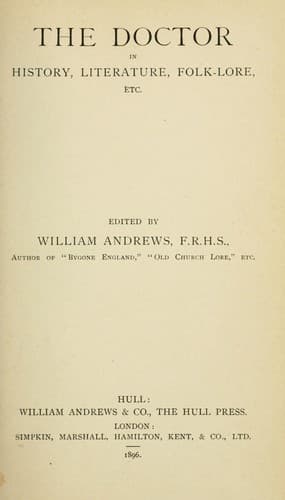
The Doctor in History, Literature, Folk-Lore, Etc.
History
The Doctor in History, Literature, Folk-Lore, Etc.
Literature and medicine; Physicians; Physicians in literature
His return to London, as a teacher of surgery and anatomy, was a marked
success, though private practice had to grow. In 1776, he was appointed
surgeon extraordinary to His Majesty George III., but eleven years prior
to this was admitted a Fellow of the Royal Society, slightly in advance of
his elder brother. Then in 1768, the bachelor, William, shifted himself
and his museum from Jermyn Street to Windmill Street, and resigned the
lease to John, thus securing independent action to the latter, and
facilities for creating a natural-history museum of his own.
Hitherto, the brothers had worked together in unison, but now John
committed the unpardonable offence of bringing home to Jermyn Street "a
tocherless bride," fourteen years younger than himself, endowed only with
beauty and accomplishments, and a faculty for filling the house with
assemblies of wit and fashion, which blunt-spoken John designated
"kick-ups," no doubt with an irreverent big D as a prefix, swearing being
as characteristic as hard work.
And work hard he did, early and late, not merely to maintain his extensive
and lucrative practice, but to provide and prepare subjects for the museum
in the rear of his town house, and for the valuable and original lectures
he delivered in language forcible and clear, if neither refined nor
academic.
His chief workshop, so to speak, was at his country "Box" at Earl's Court,
the grounds of which he had converted into a zoological garden, so many
wild animals were there kept for study. There is a story told of his
facing an escaped lion and flicking him back to his den with his pocket
handkerchief, showing his fearlessness and his knowledge of leonine
nature.
Another tale is told of his intervention between fighting dogs and
leopards, he dragging the infuriated leopards back to their cage by their
collars--and _fainting_ when the feat was accomplished, for his was not a
burly frame, and his heart was in a threatening condition.
An element of humour mingles with the gruesome in Sir B. W. Richardson's
account of the ruse employed to cheat watchful executors, and obtain the
body of O'Brien the Irish Giant,[2] so as to convert it into the skeleton
now in the Hunterian Museum of the Royal College of Surgeons, Lincoln's
Inn.
Those were the days when surgeons were not particular where they obtained
subjects for their scalpels, whether from the resurrection men or from the
gallows, and John Hunter was not more dainty than his fellows. But also
from travelling shows and menageries, and from animals that died in the
Tower he was supplied. And so rapidly did his museum grow, absorbing the
bulk of his income, that ere long he had to remove to what is now
Leicester Square, and erect a building in the rear for his collection.
Public-domain text, read in full here on John Shaqi.
Reviews
Reviews
No reviews yet
Be the first to share your thoughts on this work.
Elsewhere in the archive
Join the Discussion
Join the discussion
Sign in to leave a comment or review.
Sign InorCreate an account