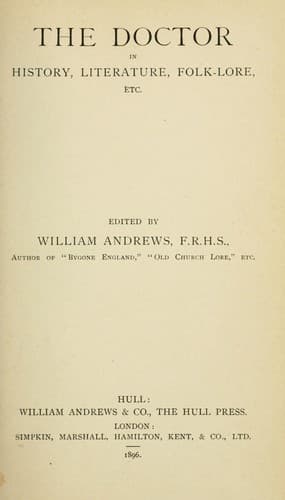
The Doctor in History, Literature, Folk-Lore, Etc.
History
The Doctor in History, Literature, Folk-Lore, Etc.
Literature and medicine; Physicians; Physicians in literature
Many have been the contributions to scientific medicine and surgery since
the rough days of the old doctors I have endeavoured to chronicle, but
these men of wigs and ties, gold-headed canes and pouncet-boxes, breeches
and buckled shoes, were the pioneers of progress, they cleared the way
for the men of this day and generation, and left their mark on their own
age, not to be effaced by newer and more advanced successors, to whom they
have served as stepping-stones.
The Lee Penny.
The story of the Lee Penny is full of historic interest, and the legends
respecting it furnished Sir Walter Scott with some incidents for his novel
the "Talisman."
This amulet is a stone of a deep red colour and triangular shape, in size
about half-an-inch on each side, and is set in a silver coin. The various
accounts which have come under our notice are agreed that this curious
relic of antiquity has been in the Lee family since a period immediately
after the death of King Robert the Bruce.
The monarch was nearing his end, and as he lay on his death-bed, he was
much troubled for having failed to visit in person the Holy Land to assist
in the Crusade. His long war with the English had rendered it impossible
for him to leave his kingdom to fight in a foreign land, even in the cause
of religion.
Sir James Douglas, his tried and trusty friend, stood beside the bed of
his king, and was in sore distress. As a last request the king implored
that as soon as possible after his soul had left his body Douglas would
take his heart to Jerusalem. On the honour of a knight, Sir James
faithfully promised to discharge the trust.
The king died in 1329, and his heart was enclosed in a silver case. Sir
James suspended it from his neck with a chain, and without delay gathered
round him a suitable retinue, and made his way towards the Holy Land. He
was not destined to reach that country, for on his route the intelligence
reached him that Alphonso, King of Leon and Castile, was waging war with
the Moorish chief, Osmyn of Granada. To assist the Christians, he felt it
was his duty, and in accordance with the dying charge of his king. With
courage he engaged in the fray, but was soon surrounded by horsemen, and
he who had fought so long and bravely, realised that he must meet his doom
far from the country he loved so well. He made a desperate effort to
escape. The precious casket he took from his neck and threw it before him,
saying, "Onward, as thou were wont, thou noble heart! Douglas will follow
thee." He followed it and was slain. After the battle was over the brave
knight was found resting on the heart of Bruce. The mortal remains of the
valiant knight were carried back to his home and buried in his church of
St. Bride, at Douglas.
Public-domain text, read in full here on John Shaqi.
Reviews
Reviews
No reviews yet
Be the first to share your thoughts on this work.
Elsewhere in the archive
Join the Discussion
Join the discussion
Sign in to leave a comment or review.
Sign InorCreate an account