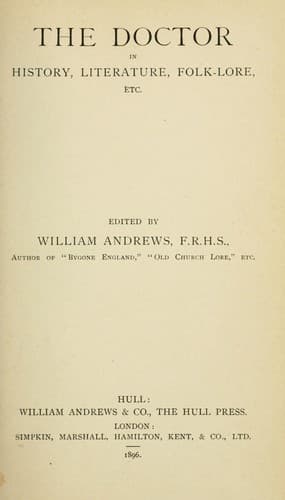
The Doctor in History, Literature, Folk-Lore, Etc.
History
The Doctor in History, Literature, Folk-Lore, Etc.
Literature and medicine; Physicians; Physicians in literature
The heart of Bruce was entrusted to Sir Simon Locard, and by him borne
back to Scotland, and at last found a resting-place beneath the high altar
of Melrose Abbey, and its site is still pointed out. Mrs. Hemans wrote a
charming poem on Bruce's heart in Melrose Abbey, commencing:--
"Heart! that did'st press forward still,
Where the trumpet's note rang shrill;
Where the knightly swords are crossing,
And the plumes like sea-foam tossing,
Leader of the charging spear,
Fiery heart! and liest thou here?
May this narrow spot inurn
Aught that could so beat and burn?"
We are told the family name of Locard was changed to Lockheart, or
Lockhart, from the circumstance of Sir Simon having carried the key of the
casket, and was granted as armorial insignia, heart with a fetter-lock,
with the motto, "Corda serrata pando." According to a contributor to
Chambers's "Book of Days," v., 2, p. 415, from the same incident, the
Douglases bear a human heart, imperially crowned, and have in their
possession an ancient sword, emblazoned with two hands holding a heart,
and dated 1329, the year Bruce died.
Lockhart was not daunted at the failure of the first attempt to reach
Jerusalem, and, in company with such Scottish knights as escaped the fate
of their leader, they once more proceeded, and arrived in the Holy Land,
and for some time fought in the wars against the Saracens.
[Illustration: THE LEE PENNY.]
The following adventure is said to have befallen him. He made prisoner in
battle an Emir of wealth and note. The aged mother of his captive came to
the Christian camp to save her son from his captivity. Lockhart fixed the
price at which his prisoner should ransom himself; and the lady, pulling
out a large embroidered purse, proceeded to tell down the amount. In this
operation, a pebble inserted in a coin, some say of the lower empire, fell
out of the purse, and the Saracen matron testified so much haste to
recover it as to give the Scottish knight a high idea of its value. "I
will not consent," he said, "to grant your son's liberty unless the amulet
be added to the ransom." The lady not only consented to this, but
explained to Sir Simon the mode in which the talisman was to be used. The
water in which it was dipped operated as a styptic, or a febrifuge, and
the amulet possessed several other properties as a medical talisman.
Sir Simon Lockhart, after much experience of the wonders which it wrought,
brought it to his own country, and left it to his heirs, by whom, and by
Clyde side in general, it was, and is still, distinguished by the name of
the Lee Penny, from the name of his native seat of Lee.
Public-domain text, read in full here on John Shaqi.
Reviews
Reviews
No reviews yet
Be the first to share your thoughts on this work.
Elsewhere in the archive
Join the Discussion
Join the discussion
Sign in to leave a comment or review.
Sign InorCreate an account