[Transcriber's Note: This printing had more than its share of typographical
errors. Obvious typos, like "tim" for "time", have been corrected.]
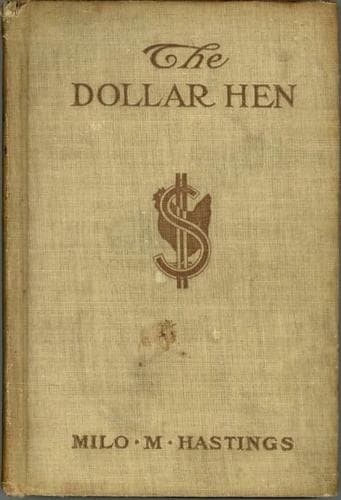
THE DOLLAR HEN
BY
MILO M. HASTINGS
FORMERLY POULTRYMAN AT
KANSAS EXPERIMENT STATION;
LATER IN CHARGE OF THE COMMERCIAL
POULTRY INVESTIGATION
OF THE UNITED STATES
DEPARTMENT OF AGRICULTURE
SYRACUSE
NATIONAL POULTRY MAGAZINE
1911
COPYRIGHT, 1911,
BY
NATIONAL POULTRY PUBLISHING COMPANY
WHY THIS BOOK WAS WRITTEN
Twenty-five years ago there were in print hundreds of complete
treatises on human diseases and the practice of medicine.
Notwithstanding the size of the book-shelves or the high standing of
the authorities, one might have read the entire medical library of
that day and still have remained in ignorance of the fact that
out-door life is a better cure for consumption than the contents of
a drug store. The medical professor of 1885 may have gone
prematurely to his grave because of ignorance of facts which are
to-day the property of every intelligent man.
There are to-day on the book-shelves of agricultural colleges and
public libraries, scores of complete works on "Poultry" and hundreds
of minor writings on various phases of the industry. Let the
would-be poultryman master this entire collection of literature and
he is still in ignorance of facts and principles, a knowledge of
which in better developed industries would be considered prime
necessities for carrying on the business.
As a concrete illustration of the above statement, I want to point
to a young man, intelligent, enterprising, industrious, and a
graduate of the best known agricultural college poultry course in
the country. This lad invested some $18,000 of his own and his
friends' money in a poultry plant. The plant was built and the
business conducted in accordance with the plans and principles of
the recognized poultry authorities. To-day the young man is bravely
facing the proposition of working on a salary in another business,
to pay back the debts of honor resulting from his attempt to apply
in practice the teaching of our agricultural colleges and our
poultry bookshelves.
The experience just related did not prove disastrous from some
single item of ignorance or oversight; the difficulty was that the
cost of growing and marketing the product amounted to more than the
receipts from its sale. This poultry farm, like the surgeon's
operation, "was successful, but the patient died."
The writer's belief in the reality of the situation as above
portrayed warrants him in publishing the present volume. Whether his
criticism of poultry literature is founded on fact or fancy may,
five years after the copyright date of this book, be told by any
unbiased observer.
Public-domain text, read in full here on John Shaqi.
Reviews
Reviews
No reviews yet
Be the first to share your thoughts on this work.
Join the Discussion
Join the discussion
Sign in to leave a comment or review.
Sign InorCreate an account