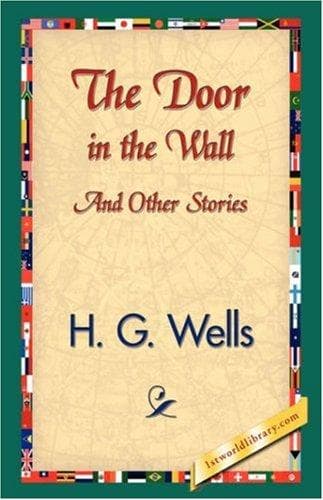
The Door in the Wall, and Other StoriesWells, H. G. (Herbert George)
Science
The Door in the Wall, and Other Stories
Wells, H. G. (Herbert George)
Fantasy fiction, English; Science fiction, English; Short stories
The light of that day went the way of its brethren, and with the later
watches of the frosty darkness rose the strange star again. And it was
now so bright that the waxing moon seemed but a pale yellow ghost of
itself, hanging huge in the sunset. In a South African City a great man
had married, and the streets were alight to welcome his return with his
bride. “Even the skies have illuminated,” said the flatterer. Under
Capricorn, two negro lovers, daring the wild beasts and evil spirits,
for love of one another, crouched together in a cane brake where the
fire-flies hovered. “That is our star,” they whispered, and felt
strangely comforted by the sweet brilliance of its light.
The master mathematician sat in his private room and pushed the papers
from him. His calculations were already finished. In a small white
phial there still remained a little of the drug that had kept him awake
and active for four long nights. Each day, serene, explicit, patient as
ever, he had given his lecture to his students, and then had come back
at once to this momentous calculation. His face was grave, a little
drawn and hectic from his drugged activity. For some time he seemed
lost in thought. Then he went to the window, and the blind went up with
a click. Half way up the sky, over the clustering roofs, chimneys and
steeples of the city, hung the star.
He looked at it as one might look into the eyes of a brave enemy. “You
may kill me,” he said after a silence. “But I can hold you—and all the
universe for that matter—in the grip of this little brain. I would not
change. Even now.”
He looked at the little phial. “There will be no need of sleep again,”
he said. The next day at noon—punctual to the minute, he entered his
lecture theatre, put his hat on the end of the table as his habit was,
and carefully selected a large piece of chalk. It was a joke among his
students that he could not lecture without that piece of chalk to
fumble in his fingers, and once he had been stricken to impotence by
their hiding his supply. He came and looked under his grey eyebrows at
the rising tiers of young fresh faces, and spoke with his accustomed
studied commonness of phrasing. “Circumstances have
arisen—circumstances beyond my control,” he said and paused, “which
will debar me from completing the course I had designed. It would seem,
gentlemen, if I may put the thing clearly and briefly, that—Man has
lived in vain.”
The students glanced at one another. Had they heard aright? Mad? Raised
eyebrows and grinning lips there were, but one or two faces remained
intent upon his calm grey-fringed face. “It will be interesting,” he
was saying, “to devote this morning to an exposition, so far as I can
make it clear to you, of the calculations that have led me to this
conclusion. Let us assume—”
Public-domain text, read in full here on John Shaqi.
Reviews
Reviews
No reviews yet
Be the first to share your thoughts on this work.
Join the Discussion
Join the discussion
Sign in to leave a comment or review.
Sign InorCreate an account