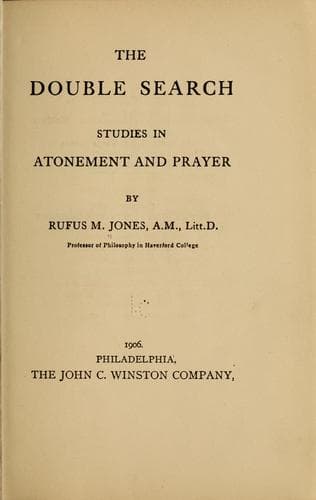
The Double Search: Studies in Atonement and PrayerJones, Rufus M. (Rufus Matthew)
Religion
The Double Search: Studies in Atonement and Prayer
Jones, Rufus M. (Rufus Matthew)
Atonement; Prayer -- Christianity
It is a bold and hazardous task to say anything on this subject and
I must tread with bare, hushed feet, for it is a holy realm which we
are essaying to enter. It must be understood from the first that I am
not going to thresh over a heap of theological straw. I am not going
into that realm of abstract metaphysics where one can always prove
any thesis one may happen to assume at the start. I shall keep close
to human experience. The pillars of our faith must be planted, not on
some artificial construction of logic, but deep down in the actual
experience of Life. There are external principles of the spiritual
Life which are as irresistible and compelling as the laws of physics
or the propositions of Euclid. The task of the religious teacher is to
discover and proclaim these elemental truths, but we always find it so
much easier to fall back on dogma and theories which have been spun out
of men’s heads! In the Gospels and in Paul’s letters the laboratory
method prevails--the writers ground their assertions on experienced
facts, they tell what they have found and verified, and they always ask
their readers to put their truths to the test of a personal experience
like their own. Our modern method must be a return to this inward
laboratory method.
No one can carefully study the theories of the atonement which
have prevailed at the various epochs of Christian history without
discovering that there has been in them a very large mixture of
paganism. They have been deeply colored by mythology and by the crude
ideas of primitive sacrifice. They start, not with the idea of God
which Christ has revealed, but with a capricious sovereign, angry at
sorely tempted, sinning man, and forgiving only after a sacrifice has
satisfied Him. They treat sin not as a fact of experience, but as the
result of an ancestral fall, which piled up an infinite debt against
the race. They all move in the realm of law rather than in the domain
of personality. They are all, more or less, vitiated by abstract and
mathematical reasoning, while sin and salvation are always affairs of
the inward life, and are of all things personal and concrete. The first
step to a coercive conception of the atonement is to get out of the
realm of legal phrases into the region of personality.
Public-domain text, read in full here on John Shaqi.
Reviews
Reviews
No reviews yet
Be the first to share your thoughts on this work.
Join the Discussion
Join the discussion
Sign in to leave a comment or review.
Sign InorCreate an account