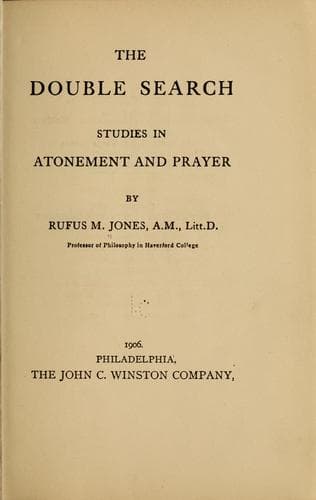
The Double Search: Studies in Atonement and PrayerJones, Rufus M. (Rufus Matthew)
Religion
The Double Search: Studies in Atonement and Prayer
Jones, Rufus M. (Rufus Matthew)
Atonement; Prayer -- Christianity
All that I have said, and much more, gets vivid illustration in the
“Lord’s prayer,” which Christians have taken as a model form, though
they have not always penetrated its spirit. It is in every line a
prayer of fellowship and co-operation. It is a perfect illustration
of the social nature of prayer. The co-operation and fellowship are
not here confined, and they never are except in the lower stages, to
the inward communion of an individual and his God. There is no _I_ or
_me_ or _mine_ in the whole prayer. The person who prays spiritually
is enmeshed in a _living group_ and the reality of his vital union
with persons like himself clarifies his vision of that deeper Reality
to whom he prays. Divine Fatherhood and human brotherhood are born
together. To say Father to God involves saying “brother” to one’s
fellows, and the ground swell of either relationship naturally carries
the other with it, for no one can largely realize the significance of
brotherly love without going to Him in whom love is completed.
“Hallowed be thy name” is often taken in a very feeble sense to
mean “keep us from using thy name in vain,” or it is thought of as
synonymous with the easy and meaningless platitude, “Let thy name
be holy.” It is in reality a heart-cry for a full appreciation of
the meaning of the Divine name, i. e., the Divine character. It is
an uprising of the soul to an apprehension of the holiness of God
and the fullness of His life that the soul may return to its tasks
with a sense of infinite resources and under the sway of a vision of
the true ideal. This Lord’s prayer begins with a word of intimate
relationship and social union--“Our Father.” It then goes out beyond
the familiar boundaries of experience to feel the infinite sweep of
God’s completeness and perfectness and to become penetrated with solemn
awe and reverence which fit such companionship,--“Our Father of the
holy name.”
This is the prelude. The true melody of prayer, if I may say so, begins
with the positive facing of the task of life:--“Thy kingdom come, Thy
will be done on earth as it is in heaven.” Here again we have the
loftiest Fellowship. The person who prays this way is linked with God
in one mighty spiritual whole. The last vestige of atomic selfishness
is washed out. There are those who say these words of prayer with
folded hands and closed eyes, and then expect the desired kingdom
to come by miracle; they suppose that if the request is made often
enough a millennium age will drop out of the skies. Ah, no! If God is
Spirit and man is meant to be spiritual, such a millennium is a sheer
impossibility. This prayer involves the most strenuous life that ever
was lived. To pray seriously for the coming of the kingdom of heaven
means to contribute to its coming. It _has_ come in any life which is
completely under the sway of the holy Will and which is consecrated to
the task of making that holy Will prevail in society. It is no “far
off Divine event.” It is always coming.
Public-domain text, read in full here on John Shaqi.
Reviews
Reviews
No reviews yet
Be the first to share your thoughts on this work.
Join the Discussion
Join the discussion
Sign in to leave a comment or review.
Sign InorCreate an account