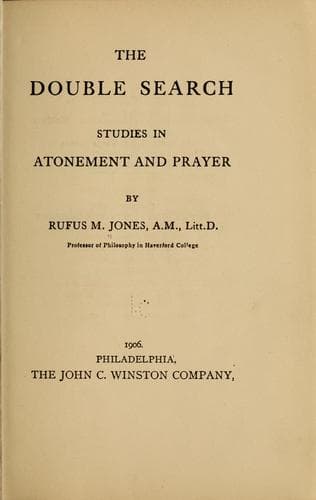
The Double Search: Studies in Atonement and PrayerJones, Rufus M. (Rufus Matthew)
Religion
The Double Search: Studies in Atonement and Prayer
Jones, Rufus M. (Rufus Matthew)
Atonement; Prayer -- Christianity
Next we come to the profound word which shows how completely our lives
are bound together in organic union, above and below: “Forgive us as
we forgive.” What a solemn thing to say. Dare we pray it! And yet few
words have ever so truly revealed the nature of prayer. It is, one
sees, no easy, lazy way to blessings. Once more, it is co-operation.
Forgiveness is not a gift which can fall upon us from the skies, in
return for a capricious request. The blessing depends on us as much as
it does on God. A cold, hard, unforgiving heart can no more be forgiven
than a lazy, slipshod student can have knowledge given to him. Like all
spiritual things, forgiveness can come only when there is a person who
appreciates its worth and meaning. The deep cry for forgiveness must
rise out of a forgiving spirit. It is always more than a transaction,
an event. It is an inward condition of the personal life, and the soul
that feels what it means to love and forgive is so bound into the whole
divine order that love and forgiveness come in as naturally as light
goes through the open casement, or the tide into an inlet.
The next word is surely to be thought of as a human cry: “Take us not
into testing.” It is the natural shrinking of the tender, sensitive
soul, and it is the right attitude. Most of us know by hard experience
that trial, proving, testing, yes, even actual temptation, have a
marvelous ministry. No saint is made in the level plain, where the
waters are still and the pastures green.
“Never on custom’s oilëd grooves
The world to a higher level moves,
But grates and grinds with friction hard
On granite boulder and flinty shard.
The heart must bleed before it feels,
The pool be troubled before it heals.”
All this we know. We know that the stem battle makes the veteran. But
this prayer is the childlike cry, the shrinking fear, which are always
safer than the bold dash, the impetuous plunge. It is the utterance of
an instinctive wish to keep where safety lies, and, humanly speaking,
it is right, though, in a world whose highest fruit is character,
we may expect that bitter cups and hard baptisms will be a part of
our experience. Like all that has gone before, it is an effort at
co-operation. It is a sincere aspiration for green pastures and still
waters joined with a readiness to be fed at the table in presence of
the enemy, if need be, readiness for the perilous edge of conflict, for
“high strife and glorious hazard.”
Last of all there rises the cry for deliverance from the power of
evil. Once more we realize that this is not an occasion for magical
interference, no call for a fiery dart out of the sky to pierce a black
demon who is pushing us into sin. The drama is an inward one and the
enemy, called of many names, is a part of our own self. Each soul has
its own struggle with the immemorial tug of brute inheritance--the sag
of lower nature.
Public-domain text, read in full here on John Shaqi.
Reviews
Reviews
No reviews yet
Be the first to share your thoughts on this work.
Join the Discussion
Join the discussion
Sign in to leave a comment or review.
Sign InorCreate an account