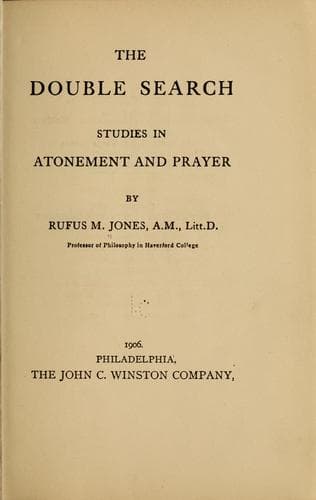
The Double Search: Studies in Atonement and Prayer — John Shaqi
The Double Search: Studies in Atonement and PrayerJones, Rufus M. (Rufus Matthew)
Religion
The Double Search: Studies in Atonement and Prayer
Jones, Rufus M. (Rufus Matthew)
Atonement; Prayer -- Christianity
So long as the processes of evolution were confined to the plant
and brute there could be no revelation of anything but force; or at
most there could be only dawnings of anything higher. The forms of
life which won in the struggle and survived were manifestations of
power--they hardly implied anything more. The tough spine and the
strong jaw and the sharp claw were all that mattered. Everything that
appeared was pushed into existence by a force from behind. There was no
sign or hint of freedom, or of life formed under the sway of a vision
or an ideal. Things moved “for a million aeons through the vast, waste
dawn” toward a goal, but the goal was never in sight and it played no
part in the process.
John Fiske has, somewhere, denied the truth of the proverb that “nature
abhors leaps,” and he has given a beautiful illustration from the
cutting of a cone. If you pass a plane parallel to the base of a cone
you cut a circle. If you tilt the plane slightly the curve becomes an
ellipse. The ellipse grows more eccentric as the tilting increases and
finally without any warning your plane cuts a parabola whose sides
curve off into infinity and never touch ends again. Some such mighty
leap appears in the process of evolution. Up to a certain point life
evolved by forces working _a tergo_.[2] There is a slight tilt in the
system and a being appears capable of selecting a goal for himself and
of acting to attain it, a being who could live in some degree for a
world as it ought to be.[3]
This is what in America we call “the great divide”--the watershed which
determines the streams of a continent. As soon as there was a being
who could select ideals and live for conscious ends a new kind of
evolution began. The other side of “the divide,” evolution had been
physical,--body, and body function had been the goal. This side “the
divide,” it was spiritual and social, and the goal was the evolution of
the man within man. The things which mattered now were love, sacrifice,
service, goodwill rather than “tooth and claw.” Before, nature’s goal
had been along the line of least resistance. Now, the line of march set
straight against instinct and along the line of greatest resistance.
There could be advance on this side “the divide,” only as the ideal
became clearer and its sway more coercive.
Ever since man was man he has transcended the actual and lived by
vision, which means, I think, that finite and infinite are not sundered
and that we always partake of more than just ourselves. Beyond the edge
of what we are there is always dawning a farther possibility--that
which we ought to be--the _a fronte_ compulsion.[4] This is one of
God’s ways of revealing Himself. It is a man’s chief glory--the glory
of the imperfect.
Public-domain text, read in full here on John Shaqi.
Reviews
Reviews
No reviews yet
Be the first to share your thoughts on this work.
Join the Discussion
Join the discussion
Sign in to leave a comment or review.
Sign InorCreate an account