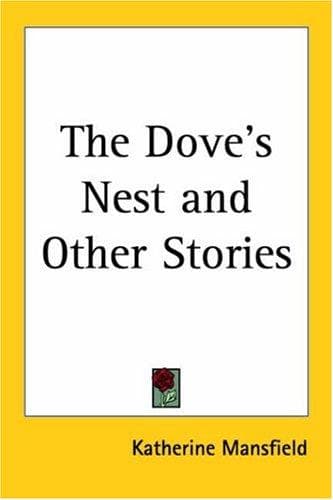
The Doves' Nest, and Other StoriesMansfield, Katherine
General
The Doves' Nest, and Other Stories
Mansfield, Katherine
Fiction; Short stories, New Zealand
Why? Ah, there you have me! There is the most difficult question of all
to answer. Why do people stay together? Putting aside “for the sake
of the children,” and “the habit of years” and “economic reasons” as
lawyers’ nonsense—it’s not much more—if one really does try to find out
why it is that people don’t leave each other, one discovers a mystery.
It is because they can’t; they are bound. And nobody on earth knows
what are the bonds that bind them except those two. Am I being obscure?
Well, the thing itself isn’t so frightfully crystal clear, is it? Let me
put it like this. Supposing you are taken, absolutely, first into his
confidence and then into hers. Supposing you know all there is to know
about the situation. And having given it not only your deepest sympathy
but your most honest impartial criticism, you declare, very calmly, (but
not without the slightest suggestion of relish—for there is—I swear there
is—in the very best of us—something that leaps up and cries “A-ahh!”
for joy at the thought of destroying), “Well, my opinion is that you
two people ought to part. You’ll do no earthly good together. Indeed,
it seems to me, it’s the duty of either to set the other free.” What
happens then? He—and she—agree. It is their conviction too. You are only
saying what they have been thinking all last night. And away they go to
act on your advice, immediately.... And the next time you hear of them
they are still together. You see—you’ve reckoned without the unknown
quantity—which is their secret relation to each other—and that they can’t
disclose even if they want to. Thus far you may tell and no further. Oh,
don’t misunderstand me! It need not necessarily have anything to do with
their sleeping together.... But this brings me to a thought I’ve often
half entertained. Which is that human beings, as we know them, don’t
choose each other at all. It is the owner, the second self inhabiting
them, who makes the choice for his own particular purposes, and—this
may sound absurdly far-fetched—it’s the second self in the other which
responds. Dimly—dimly—or so it has seemed to me—we realize this, at any
rate to the extent that we realize the hopelessness of trying to escape.
So that, what it all amounts to is—if the impermanent selves of my wife
and me are happy—_tant mieux pour nous_—if miserable—_tant pis_.... But
I don’t know, I don’t know. And it may be that it’s something entirely
individual in me—this sensation (yes, it is even a sensation) of how
extraordinarily _shell-like_ we are as we are—little creatures, peering
out of the sentry-box at the gate, ogling through our glass case at the
entry, wan little servants, who never can say for certain, even, if the
master is out or in....
The door opens.... My wife. She says, “I am going to bed.”
And I look up vaguely, and vaguely say, “You are going to bed.”
“Yes.” A tiny pause. “Don’t forget—will you?—to turn out the gas in the
hall.”
And again I repeat, “The gas in the hall.”
Public-domain text, read in full here on John Shaqi.
Reviews
Reviews
No reviews yet
Be the first to share your thoughts on this work.
Join the Discussion
Join the discussion
Sign in to leave a comment or review.
Sign InorCreate an account