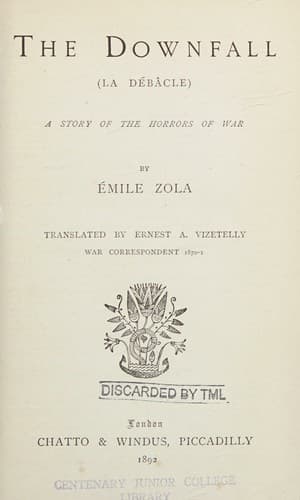
The Downfall (La Débâcle): A Story of the Horrors of WarZola, Émile
General
The Downfall (La Débâcle): A Story of the Horrors of War
Zola, Émile
Franco-Prussian War, 1870-1871 -- Fiction
The daylight was waning, when, from a distant corner of the camp, the
tattoo sounded--a roll of the drums followed by a bugle call, faint
as yet, wafted away, as it was, through the open air. It was heard,
however, by Jean Macquart,[2] who had been endeavouring to strengthen
his tent by driving the pickets deeper into the ground, and who now
rapidly rose to his feet. Still bleeding from the grievous tragedy in
which he had lost Françoise, his wife, and the land she had brought
him in marriage, he had left Rognes, and, although nine-and-thirty
years of age, had re-enlisted at the first rumour of war. Immediately
enrolled, with his old rank of corporal, in the 106th Regiment of the
Infantry of the Line, then being brought up to its full strength, Jean
sometimes felt astonished to find himself again in uniform--he who had
been so delighted to leave the service after the battle of Solferino,
so pleased to cease playing the swashbuckler, the part of the man who
kills. But what is a fellow to do when he has no trade or profession
left him, neither wife nor even a scrap of property that he can call
his own in all the wide world, and when grief and rage bring his heart
with a leap into his very throat? Surely he has a right to trounce
his country's enemies, especially if they plague him. Besides, Jean
remembered the cry he had raised: 'Ah! dash it all, he would defend the
old soil of France, since he no longer had courage enough to till it!'
On rising up he glanced at the camp, where a final stir was being
occasioned by the passage of the tattoo party. Some men were running to
their quarters; others, already drowsy, sat up or stretched themselves
out with an air of irritated weariness; whilst Jean, the patient
fellow, awaited the roll-call with that well-balanced tranquillity of
mind which made him such a capital soldier. His comrades said he would
probably have risen rapidly in rank had he been more of a scholar, but
it happened that he only just knew how to read and write, and he did
not even covet a sergeant's stripes. He who has been a peasant always
remains one.
Jean was concerned at the sight of the green logs which were still
smoking, and called to the two men--Loubet and Lapoulle, both belonging
to his squad--who were desperately endeavouring to kindle the fire:
'Just let that be. You're poisoning us with that smoke.'
Loubet, who was lithe and active, with the look of a wag, sneeringly
replied, 'It's catching alight, corporal; I assure you it is.' And
giving his comrade Lapoulle a push, he added, 'Here, _you_, why don't
you blow?'
Public-domain text, read in full here on John Shaqi.
Reviews
Reviews
No reviews yet
Be the first to share your thoughts on this work.
Join the Discussion
Join the discussion
Sign in to leave a comment or review.
Sign InorCreate an account