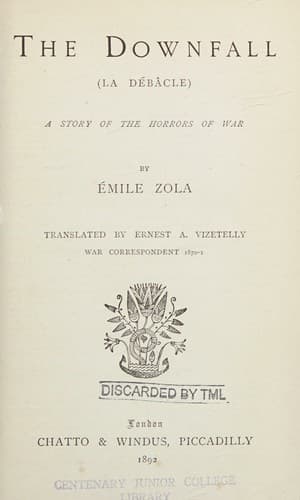
The Downfall (La Débâcle): A Story of the Horrors of WarZola, Émile
General
The Downfall (La Débâcle): A Story of the Horrors of War
Zola, Émile
Franco-Prussian War, 1870-1871 -- Fiction
Maurice was still listening to the guns as they rolled along through
the little black town down below, to the horses trotting past without
cessation, to the men flowing away towards the Meuse, towards the
terrible Unknown of the morrow. And, meantime, on the little window
curtains he still saw the Emperor's shadow pass by at regular
intervals; the shadow of that invalid, kept on his legs by insomnia,
pacing to and fro, feeling that he must needs continue on the move
despite all his sufferings, and with his ears full of the noise made by
all those horses and soldiers whom he was sending to death. So a few
hours had sufficed, and now the disaster was decided upon, accepted!
What, indeed, could they have said to each other, that Emperor and that
marshal, both of whom were aware of the calamity to which they were
marching, who in the evening had been convinced of defeat--given the
frightful situation in which the army would henceforth find itself--and
who could not have changed their opinion in the morning since the peril
was increasing hour by hour? General de Palikao's plan, the lightning
march on Montmédy, already a hazardous venture on August 22, still
susceptible, possibly, of accomplishment on the 25th, with veterans
and a captain of genius, became on the 27th an act of sheer madness
in presence of the continual hesitation of the commanders and the
increasing demoralisation of the troops. If both Emperor and marshal
knew this, why did they yield to the pitiless voices that goaded them
on in their indecision? The marshal, perhaps, had but the limited,
obedient mind of the soldier, great in its abnegation. And the Emperor,
who no longer commanded, was awaiting destiny. They were asked to give
their lives and the lives of the army, and they consented to give them.
That was the Night of the Crime--the abominable night when a nation
was murdered, for thenceforward the army was in distress, one hundred
thousand men were sent to the slaughter!
Public-domain text, read in full here on John Shaqi.
Reviews
Reviews
No reviews yet
Be the first to share your thoughts on this work.
Elsewhere in the archive
Join the Discussion
Join the discussion
Sign in to leave a comment or review.
Sign InorCreate an account