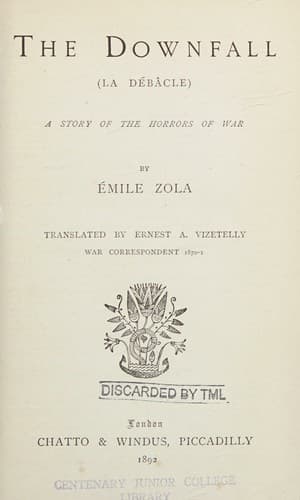
The Downfall (La Débâcle): A Story of the Horrors of WarZola, Émile
General
The Downfall (La Débâcle): A Story of the Horrors of War
Zola, Émile
Franco-Prussian War, 1870-1871 -- Fiction
Maurice was a believer in war, which he considered to be
inevitable--necessary, even, to the existence of nations. This
doctrine had imposed itself upon him since he had adopted the theory
of evolution, which already at that time impassionated young men of
culture. Is not life itself an incessant battle, which does not flag,
even for a second? Continuous fighting, the victory of the fittest, the
maintenance and renewal of strength by action, and the resuscitation of
juvenescent life from death itself--are not these the very essence of
the natural law? Maurice remembered the great transport that had buoyed
him up when, with the view of atoning for his errors, he had thought of
becoming a soldier and hurrying to the frontier. Possibly the voters
of the Plebiscitum, though surrendering themselves to the Emperor, had
not really desired war. Maurice himself, but a week previously, had
declared that such a war as was being spoken of would be both culpable
and idiotic. People were then discussing the candidature of a German
prince to the Spanish throne, and in the confusion which gradually
arose it seemed as if everybody were in the wrong. No one could say
precisely from which side the provocation had come, and only the
inevitable remained, the fatal law which at a given hour impels one
people against another. Then a great thrill swept through Paris, and
Maurice in his mind's eye still beheld the scenes of that torrid night,
the boulevards a human sea, the bands of men who waved their torches
and shouted: 'To Berlin! To Berlin! To Berlin!' And he again saw a tall
woman[4] with a sculptural figure and a queenly profile mount on a
carriage-box in front of the Hôtel de Ville, and, swathed in the folds
of a tricolour flag, chant the 'Marseillaise.' Was all that a lie? Had
not the heart of Paris really beaten that night?
As was always the case with Maurice, however, after this nervous
excitement there had come long hours of fearful wavering and disgust.
His arrival at the barracks, the adjutant to whom he had reported
himself, the sergeant who had provided him with his uniform, the
stinking and repulsively filthy dormitory, the rough familiarity of
his new companions, the mechanical exercises which had exhausted his
limbs and rendered his brain so heavy--all these had been unpleasant
experiences. In less than a week, however, he had become accustomed to
his new life, and displayed no further repugnance for it. And, indeed,
when the regiment at last set out for Belfort, enthusiasm again seized
hold of him.
Public-domain text, read in full here on John Shaqi.
Reviews
Reviews
No reviews yet
Be the first to share your thoughts on this work.
Join the Discussion
Join the discussion
Sign in to leave a comment or review.
Sign InorCreate an account